
Third-Party Access Governance: How to Control Vendor Access
Third-Party Access Governance: How to Control Vendor Access
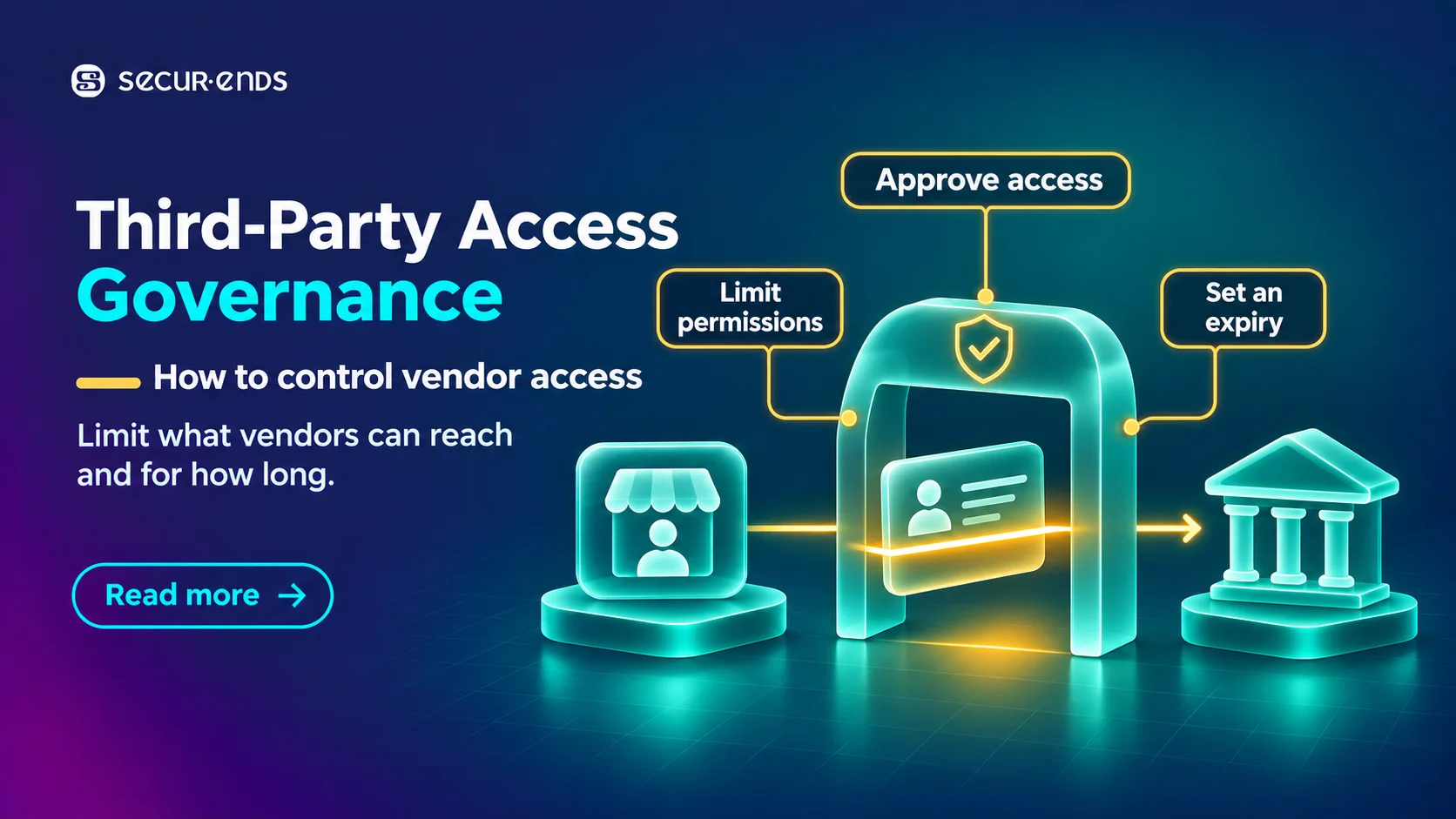
TL;DR
- Third-party access governance connects external accounts and permissions to an active engagement and an accountable internal sponsor.
- Review every access path, including local application accounts, privileged remote access, cloud roles, and service identities.
- Reassess permissions when vendor personnel, sponsors, assignments, or contracts change.
- Set expiry or review conditions based on the work and any operational dependencies.
- Verify required removals in the affected systems before closing offboarding actions.
When a Vendor Project Ends but an Admin Account Stays Active
A community bank hires a technology provider to upgrade its core banking system. Two vendor engineers receive temporary administrative access, complete the migration, and hand the project back to IT. The project closes, but one engineer’s local administrator account remains active in production.
Third-party access governance connects project closure to the permissions granted for the work. It gives the bank a way to identify the accounts involved, assign removal to the right owners, and verify that the access ended.
What Is Third-Party Access Governance?
Third-party access governance is the process of authorising, monitoring, reviewing, and removing access granted to external identities throughout their relationship with an organisation.
It covers vendor engineers, consultants, auditors, managed service providers, and technical integrations. Vendor risk management evaluates the business relationship through due diligence, contracts, and ongoing oversight. Access governance examines the individual accounts and permissions that relationship creates. An approved provider may still have personnel whose assignments have ended and whose accounts need to be removed.
Four Records Every Vendor Identity Should Connect To
External identities may sit outside the HR systems used to track employee access. Connect each account to the provider, the work it supports, its internal sponsor, and the permissions it holds.
| Element | What it establishes | Banking example |
| Vendor organisation | Which provider is involved | Core banking technology provider |
| Business engagement | Why access is needed | Scheduled production upgrade |
| Internal sponsor | Who is accountable for the business need | Banking technology manager |
| External identity and entitlement | Who or what can access a resource | Named engineer with an administrator role |
If a provider has 12 approved support personnel and only six currently work on the bank’s systems, reassess the remaining six accounts. When an internal sponsor leaves or transfers, assign a successor or escalate the ownership gap.
Which Third-Party Access Paths Need Governance?
| Access path | Typical use | Governance challenge |
| Guest identity | External collaboration and document sharing | Guest access remains active after the assignment |
| Application account | Vendor supports a banking platform | A local account sits outside the central directory |
| Privileged remote access | Engineer performs production maintenance | Standing privileges remain after maintenance ends |
| Cloud administration | Provider manages infrastructure | Access extends beyond the approved service scope |
| API or service identity | Vendor integration exchanges data | Credentials remain active without clear technical ownership |
| Shared technical account | Legacy support arrangement | Individual activity is difficult to attribute |
During offboarding, check each affected system. Disabling a guest identity or ending a remote session may leave a local administrator account active. Assess operational dependencies before changing a service identity that supports an ongoing integration.
How to Govern Vendor Access Throughout the Engagement
- Before approval. Record the provider, engagement, identity, target system, business purpose, and duration. Have the sponsor confirm the need and the application or security owner assess the requested permissions.
- When granting access. Use named accounts, scoped permissions, and defined validity periods where supported. Production maintenance may require temporary administration in one application.
- When personnel change. Establish how the provider reports departures or reassignments. Review the outgoing engineer’s access when onboarding a replacement.
- When the engagement is extended. Confirm which people and technical accounts are still needed. Reassess elevated permissions before extending them.
- When the engagement ends. Assign removals to the technical owners and verify the changes. Document any integration that must remain active and how it will be governed during transition.
How a Credit Union Found Vendor Access After a Migration
A hypothetical credit union hires a provider to migrate from a legacy reporting platform. The provider uses a local application account, a directory group, and a remote administration service. After the migration, procurement closes the project and IT disables remote access. Two weeks later, an internal review finds that a local reporting administrator account is still active.
- Trace the account. The application team confirms it was created directly in the legacy platform and was missing from the central directory inventory.
- Confirm ownership and need. The original sponsor has transferred. The current application owner confirms that the account is no longer needed.
- Remove and verify access. An authorised administrator disables the account, checks its status in the source application, and looks for similar migration accounts.
- Update the closure procedure. Link local accounts to the vendor, engagement, and sponsor. Include those accounts in the project closure review.
How to Set Vendor Access Expiry and Review Conditions
| Access arrangement | Control approach to evaluate |
| Temporary implementation project | Approved start and end dates with controlled extensions |
| Privileged maintenance work | Time-limited or on-demand elevated access where supported |
| Ongoing vendor support | Named ownership and risk-based reassessment |
| External audit engagement | Restricted resources and access duration aligned with the assignment |
| Critical service integration | Documented technical owner and controlled transition or termination |
| Emergency support access | Defined authorisation, oversight, and post-use review |
When immediate removal could interrupt banking operations, document the dependency and approve a controlled transition. Keep the owner, safeguards, and reassessment date visible until the access changes.
Who Should Review Third-Party Permissions?
- Business sponsor: Confirms that the engagement and individual assignment remain valid.
- Application owner: Determines whether the technical permission is necessary.
- Security or privileged access owner: Evaluates elevated access and applicable safeguards.
- Vendor management: Confirms contract status and other relationship details.
Define who has final authority to retain, modify, or remove access. Escalate cases where the reviewer cannot establish ownership or business need.
How Third-Party Access Governance Fits With TPRM, PAM, and IAM
| Technology | Primary responsibility | What to verify |
| Third-party risk management (TPRM) | Evaluate and oversee vendor relationships | Whether it tracks individual technical permissions |
| Privileged access management (PAM) | Protect privileged credentials, sessions, and elevated access | Whether ordinary vendor application access is covered |
| Identity governance and administration (IGA) | Connect identities to permissions, owners, reviews, and lifecycle actions | Which application changes it can implement or verify |
| Identity and access management (IAM) | Authenticate identities and provision supported accounts | Whether it supports business certification and evidence workflows |
A bank might use TPRM to assess a core processing provider, PAM to control engineers’ privileged sessions, and IGA to review which external accounts should remain authorised.
How to Evaluate Third-Party Access Governance Software
Ask vendors to demonstrate the following capabilities using the banking systems and permission types in scope.
| Evaluation area | What to ask | Evidence to request |
| External identity visibility | Can it identify vendor accounts across connected applications? | Identity and account records |
| Sponsor ownership | Can each identity be linked to an accountable sponsor? | Sponsor assignments and reassignment history |
| Business context | Can access be linked to an engagement and purpose? | Engagement-to-identity mapping |
| Entitlement visibility | Can reviewers understand what each permission allows? | Source-system roles and descriptions |
| Access expiry | Can temporary access expire or trigger reassessment? | Demonstrated expiry workflow |
| Review routing | Can the right owners assess sensitive permissions? | Certification and escalation history |
| Lifecycle triggers | Can personnel or engagement changes initiate actions? | Trigger configuration and completed events |
| Remediation | How are rejected permissions removed? | Provisioning actions or linked manual tasks |
| Verification | Can the institution confirm that changes took effect? | Updated source-system permission records |
| Historical reporting | Can earlier decisions and outcomes be reconstructed? | Decision and remediation history |
Document where connectors can discover accounts but cannot see detailed roles or apply changes. Assign an owner and a manual procedure for material gaps.
Five Proof-of-Concept Scenarios to Test
| Scenario | Expected result |
| New vendor engagement | The request identifies the vendor, sponsor, purpose, and entitlement |
| Vendor engineer leaves | The engineer’s access is removed while other authorised personnel retain theirs |
| Internal sponsor changes | Ownership is reassigned or escalated with a traceable history |
| Temporary privileged access expires | The permission is removed or reassessed under the approved process |
| Vendor contract ends | Associated accounts are identified and required removals are tracked and verified |
For the contract-end test, include a local banking application account outside the central directory. Ask how the solution identifies the coverage gap and how the institution will verify any manual removal.
How to Measure Vendor Access Governance
Suppose a bank identifies 150 external accounts. Of these, 135 have confirmed sponsors, 10 lack clear sponsorship, and five are under investigation. Confirmed sponsorship coverage is 90%. Review the scope and business justification of permissions separately.
| Measure | What it helps establish |
| External accounts with valid sponsors | Ownership accountability |
| Accounts linked to current engagements | Continuing business justification |
| Temporary access past its approved period | Whether expiry controls are working |
| Departed vendor personnel with outstanding accounts | Whether offboarding actions are timely |
| Privileged external access awaiting review | Where sensitive permissions need oversight |
| Rejected permissions with verified removal | Which corrective actions took effect |
| External accounts outside integration coverage | Where manual oversight is needed |
Report open exceptions with their owners and next actions so teams can act on the findings.
Regulatory Considerations for Third-Party Banking Relationships
Banks and credit unions should assess third-party access against their applicable security obligations, supervisory guidance, and institutional risks. Federal banking agency guidance addresses risk-based oversight throughout the vendor relationship, including monitoring and termination. NCUA guidance also addresses planning, due diligence, and controls suited to the credit union’s risk profile.
The OCC, Federal Reserve, FDIC, and NCUA proposed updated third-party risk management guidance in September 2026. In their November 13, 2026 announcement, the agencies extended the comment period to December 16, 2026, and described the proposed guidance as nonbinding.
Where SecurEnds Fits Into Third-Party Access Governance
SecurEnds supports identity and entitlement visibility, access certification, and remediation workflows across connected applications. User access review automation can help route decisions to accountable owners and track changes for external identities within the configured scope.
Check which vendor identity sources, local banking accounts, and manual fulfilment processes your team can include. The identity governance solution for credit unions provides a broader framework for coordinating access across banking applications and directories.
Best Practices for Third-Party Access Governance
- Record the engagement and sponsor at approval. Link the external identity to its current assignment and approved permissions.
- Set expiry or reassessment conditions when granting access. Match them to the assignment, privilege level, and operational dependencies.
- Reassess access when circumstances change. Include personnel departures, sponsor changes, project closures, and contract extensions.
- Check access outside the central directory. Include local application accounts, cloud roles, remote access, and integration identities.
- Verify removals in the affected systems. Preserve the approval, completed change, and evidence of the resulting access state.
Frequently Asked Questions
What is third-party access governance in banking?
It manages the accounts and permissions granted to vendors, consultants, and other authorised external identities. It establishes who owns the access, why it is needed, when to review it, and how to remove it.
What is the difference between vendor risk management and third-party access governance?
Vendor risk management evaluates the external business relationship through due diligence and ongoing oversight. Third-party access governance manages the individual accounts and permissions created by that relationship.
Should external vendor accounts automatically expire?
Time limits are useful for temporary assignments, particularly those with elevated privileges. Ongoing support and critical integrations may require controlled continuity. Set expiry or reassessment conditions based on business need, risk, and operational dependencies.
Who should approve access for third-party users?
The internal sponsor should confirm the engagement and business need. The application owner should assess the requested permissions, and sensitive or privileged access may require additional security approval. Define who has final authority for each decision.
Can disabling a vendor guest account remove all vendor access?
A guest account controls only the access associated with that identity. Check for separate application accounts, privileged credentials, directory groups, cloud roles, and integrations, then verify required removals in the affected systems.
What features should banks prioritise in third-party access governance software?
Prioritise external identity visibility, sponsor ownership, entitlement detail, expiry, review routing, remediation tracking, and historical evidence. Test the platform against actual banking applications and include departures, sponsor changes, and incomplete removals in the pilot.
Do banking regulators require third-party access governance software?
There is no universal requirement to purchase a specific platform. Banks and credit unions must manage applicable security and third-party risks under their relevant frameworks. Software can support oversight, while the institution remains responsible for accountable decisions, effective controls, and verified corrective actions.
Verify Vendor Access at the End of Every Engagement
Start with one completed vendor engagement. Trace each account and permission to the approved work, identify any access that remains necessary, and verify required removals in the systems that granted them. Use the results to update the offboarding procedure wherever an account, owner, or verification step was missed.




