
Identity Governance Audit Evidence: Proving Access Changes
Identity Governance Audit Evidence: Proving Access Changes
TL;DR
- Identity governance audit evidence connects an access decision to the permission it affected and the outcome in the target system.
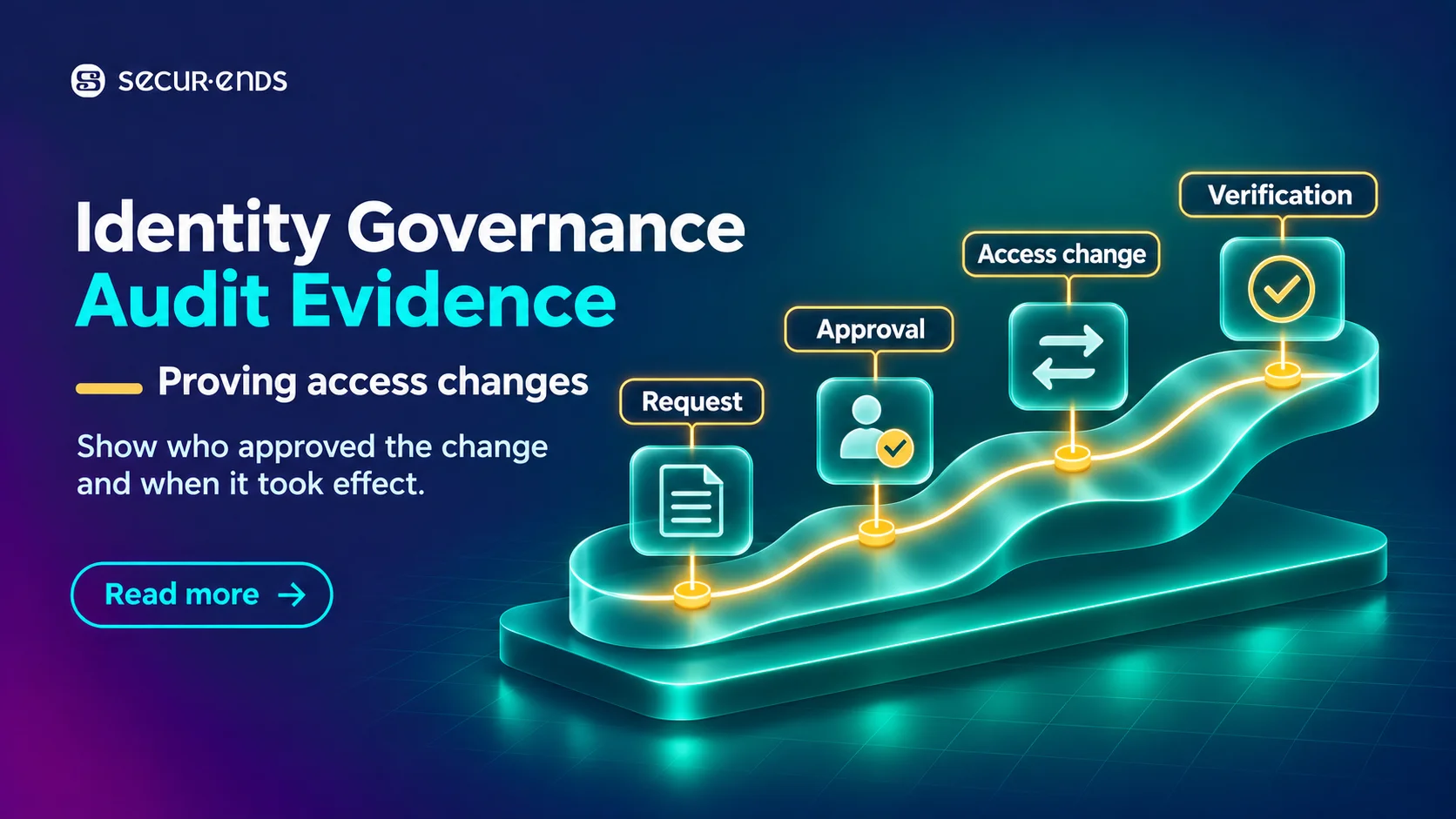
- Match four records for sensitive changes: the original access, review decision, remediation action, and verified access state.
- Use stable identity, account, and entitlement identifiers to reconcile records across systems.
- Preserve dated evidence for historical audits and document any gaps in connector coverage.
- Track completed decisions and verified revocations separately so unresolved access remains visible.
When a Closed Ticket Leaves a Banking Permission Active
A bank completes its quarterly access certification campaign, and IT closes the related remediation tickets. During an internal audit, a reviewer selects one rejected entitlement and asks whether that specific permission was removed from the banking application.
The governance report shows a rejection. The service desk shows a closed ticket. The application export still lists the employee’s access. Each record describes a different stage of the process. Identity governance audit evidence connects those records so the bank can establish what changed and whether the intended restriction took effect.
What Is Identity Governance Audit Evidence?
Identity governance audit evidence is the information used to demonstrate how identities and their permissions were authorised, reviewed, changed, and removed across an organisation’s systems.
It can include access requests, approvals, account inventories, certification decisions, provisioning records, remediation tickets, and source-system reports. Choose evidence that answers three questions: what happened, which account and entitlement were affected, and what access remained afterward.
What Each Access Review Record Can Establish
Depending on the application, a rejected entitlement may trigger an automated update, a service desk ticket, or a manual change. Each record supports a specific conclusion.
| Recorded event | What it establishes | What still needs verification |
| Certification completed | The campaign reached its defined completion point | Whether all resulting access changes took effect |
| Reviewer rejected access | A decision was recorded for an entitlement | Whether the entitlement was removed |
| Remediation ticket closed | A workflow or task was marked complete | Whether the correct source-system permission changed |
| Group membership removed | A specific group assignment changed | Whether another access path remains |
| Effective access tested | The restriction worked within the tested scope | Whether other relevant access paths were covered |
Four Records That Should Agree
Original Access
Capture the application, specific account, and entitlement before the review. A local lending approval role and a directory group that grants reporting access are separate permissions, even when both support lending work.
Review Decision
Record the reviewer, timestamp, outcome, and business justification where required. Preserve the history if the decision was delegated or reassigned.
Remediation Action
Link the decision to the provisioning operation, service ticket, or manual task. The change record should identify the same target application and entitlement that the reviewer evaluated.
Verified Access State
Use an updated entitlement report, a system-generated change record, or authorised testing to confirm the result. Check inherited permissions and alternate assignments where they could preserve the access.
How to Match Identity Governance Evidence Across Systems
An employee may have an HR identifier, a directory username, and a separate core banking account. An entitlement can also have a business-friendly name in the governance platform and a technical identifier in the application. Use stable identifiers and documented mappings to connect those records.
| Evidence field | Purpose | Example |
| Identity ID | Identify the person or technical identity | Internal identity reference |
| Account ID | Identify the specific application account | Core banking account identifier |
| Application ID | Identify the target system | Lending application reference |
| Entitlement ID | Identify the permission being evaluated | Role or group identifier |
| Review decision ID | Identify the governance decision | Certification item reference |
| Remediation ID | Connect the decision to the required change | Ticket or provisioning job reference |
| Verification reference | Identify the evidence of the outcome | Source-system report or test record |
Avoid matching by employee name or role description alone. Check for separate local and privileged accounts. If authoritative identifiers are unavailable, document the matching method and its limitations.
How a Credit Union Found the Wrong Permission Had Been Removed
A hypothetical credit union transfers an employee from lending operations to branch management. The employee has a directory group that grants access to financial reports and a local lending approval role in core banking. During certification, the reviewer rejects the lending approval role.
- Compare the records. The governance platform shows the rejection, and the service desk shows a completed removal. The entitlement identifiers reveal that the administrator removed the reporting group while the lending approval role stayed active.
- Correct the access. The application owner confirms the approval role is unnecessary. An authorised administrator removes it, and the credit union verifies the result against updated application records.
- Fix the mapping. The team corrects the relationship between the review decision and the technical entitlement. It adds a verification step for sensitive removals and checks whether similar decisions triggered the wrong changes.
Five Tests for Reliable Identity Governance Evidence
| Evidence test | Question to answer | Example of a failed test |
| Population completeness | Were relevant identities and permissions included? | Local administrator accounts are absent |
| Identity correlation | Do records refer to the same identity and account? | Two employees are matched by similar names |
| Decision traceability | Can the reviewer and outcome be identified? | A decision has no reliable reviewer history |
| Remediation matching | Does the change address the rejected entitlement? | A reporting group is removed instead of the required lending role |
| Outcome verification | Does the evidence support the intended source-system state? | A ticket is closed while access remains active |
Apply each test to the control under review. An accurate decision helps establish reviewer intent. Population reconciliation and source-system verification support separate conclusions about coverage and implementation.
Why Historical Snapshots Matter
An entitlement report generated in November shows the permissions recorded in November. To establish who held privileged access at the end of June, use a dated export, historical log, certified snapshot, or other record that covers June.
Record the period represented, collection date, source system, filters, and exclusions. Keep a history of later corrections. Restrict editing and deletion according to your security and retention policies. Version history, access logs, and integrity checks help establish how a record was handled, while reconciliation helps assess whether the original data was complete.
How to Reconcile Governance Reports With Source-System Access
Consider a campaign with 250 in-scope access items.
| Outcome | Number |
| Retain decisions recorded | 205 |
| Revoke decisions with verified removal | 25 |
| Revoke decisions awaiting verified removal | 12 |
| Decisions not yet resolved | 8 |
| Total in-scope items | 250 |
The decision completion rate is 96.8% because 242 of 250 items have retain-or-revoke decisions. The verified revocation rate is 67.6% because 25 of 37 revoke decisions have confirmed removals. Twenty items remain unresolved, including 12 removals awaiting verification and eight items awaiting a decision.
| Metric | Why it matters |
| In-scope population reconciled | Establishes confidence in review coverage |
| Decisions completed | Measures certification progress |
| Rejected permissions awaiting action | Identifies outstanding remediation |
| Revocations verified | Shows confirmed corrective outcomes |
| Unmatched identity or entitlement records | Reveals reconciliation gaps |
| Material access paths outside review coverage | Highlights limits in effective-access visibility |
Investigate changes in these measures. For example, an increase in unmatched accounts may reflect improved discovery and reveal where identity records need attention.
What If a Legacy Banking Application Cannot Export Detailed Evidence?
Use a documented manual process where integration is limited. An administrator can collect a dated permission record before review, implement the approved change, and capture the resulting access state afterward. Record the account, entitlement, source, and dates. Consider independent review for sensitive manual changes.
Document what each connector can see, including any local roles, groups, or resource-level permissions outside its coverage. Also record which changes require manual fulfilment so an auditor can trace them to the source system.
How to Test an Identity Governance Platform’s Audit Reporting
Ask the vendor to reconstruct a sensitive access revocation using representative banking-system records. Include a ticketed or manual change if that reflects how the institution operates.
| Evaluation question | Expected demonstration |
| Which account and entitlement were reviewed? | Accurate source-system correlation |
| What population was included? | Clear review scope and documented exclusions |
| Who made the decision? | Reviewer, outcome, timestamp, and relevant history |
| What change was required? | A correctly mapped remediation action |
| Was the change implemented? | Fulfilment status and supporting evidence |
| Was access actually removed? | Source-system verification or a documented limitation |
| Can the record be retrieved later? | Historical reporting for the relevant period |
Where Identity Governance Automation Supports Audit Evidence
Automation can help collect entitlement records, correlate identities, preserve decision history, and track corrective actions. Evaluate user access review workflows against the applications and permissions in scope. Use source-system verification and independent testing where the audit conclusion requires them.
SecurEnds supports identity and entitlement visibility, access certification, remediation tracking, and reporting across connected applications. Credit unions coordinating access oversight across banking, lending, and directory systems can refer to the identity governance framework for credit unions.
Best Practices for Identity Governance Audit Evidence
- Reconcile the population before reviewing results. Check for missing local accounts, privileged roles, and inherited access.
- Link decisions using stable identifiers. Match the specific account, application, and entitlement across approval, remediation, and verification records.
- Verify sensitive changes in the affected system. Confirm the intended permission changed and check any relevant alternate access paths.
- Preserve dated evidence. Record the source, time period, filters, and subsequent corrections.
- Keep unresolved items visible. Track pending decisions, failed changes, and removals awaiting verification.
Frequently Asked Questions
What is identity governance audit evidence?
It is the set of records showing how access was authorised, reviewed, modified, and removed. It may include inventories, entitlement assignments, approvals, certification decisions, remediation tasks, and source-system verification.
How is an identity governance audit trail different from a certification report?
A certification report documents the scope, reviewers, decisions, and status of an access review. An audit trail can also include earlier approvals, provisioning events, entitlement changes, and removal records. Auditors may need both to reconstruct a permission’s history.
Why is identity reconciliation important for banking audit evidence?
Employees can have different usernames and account identifiers across banking applications. Reconciliation connects those accounts to the correct person or technical identity so decisions and changes can be matched to the intended entitlement.
Does a completed revocation ticket prove that access was removed?
A closed ticket shows that a task was marked complete. Verify the specific entitlement in the source system and check inherited permissions where relevant.
Can legacy banking systems provide reliable identity governance audit evidence?
Yes. Dated manual exports, administrator records, and controlled change procedures can support an audit when the account, permission, source, and scope are clear. Sensitive changes may warrant independent verification.
How long should identity governance audit records be retained?
Retention depends on applicable legal, regulatory, contractual, and institutional requirements. Define retention by evidence type, protect historical records from unauthorised changes, and keep them retrievable for the relevant audit periods.
What should banks evaluate in identity governance audit reporting software?
Check identity matching, entitlement visibility, review history, remediation mapping, source-system verification, and historical retrieval. Use a proof of concept to see whether an independent reviewer can reconstruct a sensitive access decision across the systems involved.
Make Every Access Decision Traceable to Its Outcome
Select one sensitive revocation and trace it through the governance platform, service desk, and target application. Confirm that the records refer to the same account and entitlement, document why access changed, and show that the intended restriction took effect. Any gap in that chain gives the institution a specific control or evidence issue to address.




