
Privileged Access Reviews: What Banks Should Verify Before Automating
Privileged Access Reviews: What Banks Should Verify Before Automating
TL;DR
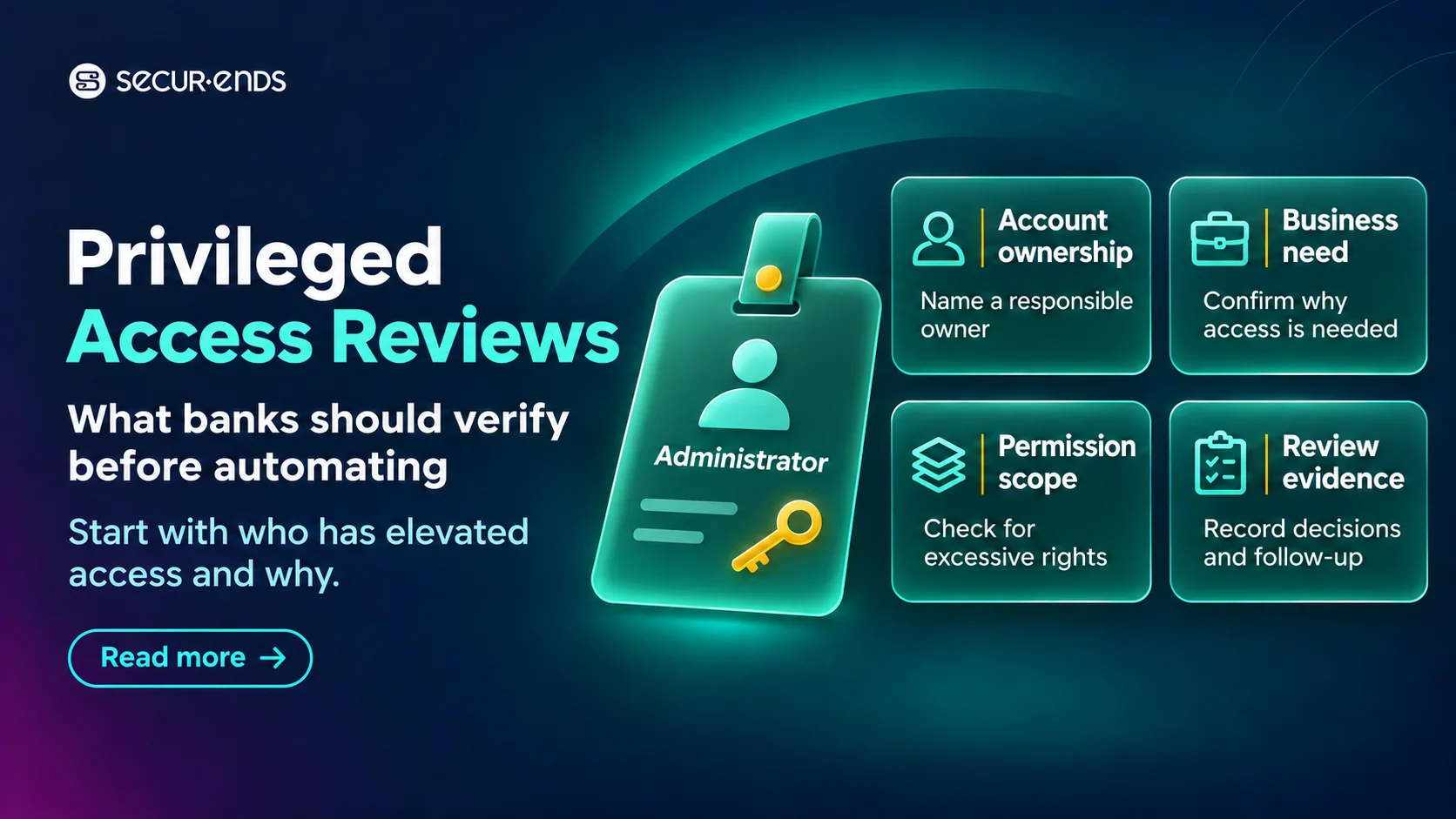
- Privileged access reviews should establish who holds elevated permissions, what those permissions allow, and whether they remain necessary.
- Check whether review software captures direct and inherited privileges across critical banking applications.
- Test a realistic case, such as a former vendor with an active administrator account, from discovery through verified removal.
- Track verified revocations, pending actions, and open investigations separately from campaign completion.
- Evaluate how review workflows fit with existing privileged access management (PAM) and IT service management (ITSM) tools.
When a Completed Review Leaves a Vendor Account Active
A credit union completes its quarterly administrator access review. Every manager submits their decisions, the dashboard shows 100% completion, and the compliance team exports the final report.
During the next internal audit, the team discovers that a former technology vendor still has an active administrator account. The account was marked for removal, but the change never reached the banking application.
This is where privileged access reviews need to go beyond collecting approvals. Banks and credit unions need to identify elevated permissions, give reviewers enough context to make defensible decisions, and confirm that approved removals take effect.
Which Privileged Identities Should Banks Review?
A privileged access review assesses whether employees, administrators, vendors, and technical identities should retain elevated permissions. These permissions can allow users to change security configurations, manage accounts, or alter sensitive records.
Privileged access can sit in core banking, lending, directory, database, cloud, and vendor support systems. It can also be assigned directly or inherited through groups and application roles. Review each account’s owner, actual authority, and business purpose.
| Account category | Banking example | What needs verification |
| Core banking administrators | Users managing application configuration | Whether broad administrative authority is still required |
| Directory administrators | Active Directory or identity platform admins | Whether inherited privileges match assigned responsibilities |
| Database administrators | Users maintaining production financial databases | Whether sensitive data and configuration access are justified |
| Cloud administrators | Users controlling cloud infrastructure | Whether standing elevated privileges are necessary |
| Third-party administrators | Vendor support accounts | Whether access remains authorised and appropriately restricted |
| Service accounts | Accounts running banking integrations | Ownership, permissions, and operational dependencies |
| Emergency accounts | Break-glass access for critical incidents | Authorisation, monitoring, and use restrictions |
Before changing a service account, confirm its operational dependencies. Disabling an account that supports transaction processing could interrupt banking operations.
Seven Capabilities to Evaluate in Privileged Access Review Software
Privileged Entitlement Visibility
Check whether the platform collects meaningful permission details from critical systems, including direct entitlements, inherited group privileges, and application-specific roles.
Account Ownership
Evaluate how the platform links separate administrator accounts, vendor identities, and technical accounts to accountable owners. Unmatched accounts should remain visible as exceptions.
Reviewer Context
An entitlement labelled “Administrator” gives reviewers limited information. Show reviewers the affected system, permission scope, identity, and business purpose, along with relevant changes or prior decisions.
Risk-Based Certification
Apply review schedules, escalation rules, and independent approval requirements according to institutional policy. Broad authority over a critical financial system may warrant closer oversight than narrowly scoped support access.
Exception Management
For access that cannot be removed immediately, record the business reason, accountable owner, risk assessment, and intended resolution. Keep the exception visible for reassessment.
Remediation Tracking
Determine what happens when a reviewer selects “revoke.” The action may be fulfilled by an integration, a service-management ticket, or an administrator. Track pending actions, failures, and escalations through resolution.
Verifiable Audit Evidence
The review record should connect the identity, entitlement, reviewer, decision, justification, timestamp, and any exception to the resulting corrective action.
A Practical Software Evaluation Scorecard
Use the same criteria and test scenarios for each vendor. Score each category from 0 for unsupported to 5 for fully demonstrated against your requirements.
| Evaluation area | Weight | What a strong demonstration should prove |
| Account and entitlement coverage | 20% | Relevant privileges are collected accurately from critical systems |
| Identity and ownership mapping | 15% | Administrative and technical accounts have accountable owners |
| Reviewer context | 15% | Reviewers can understand and justify access decisions |
| Risk-based review workflows | 15% | Sensitive access receives appropriate oversight |
| Remediation and verification | 20% | Rejected permissions are tracked through confirmed resolution |
| Audit evidence and reporting | 15% | Decisions, exceptions, and outstanding actions remain traceable |
| Total | 100% |
Adjust these illustrative weights to reflect your institution’s priorities. Treat coverage of required banking applications as a separate decision criterion so a high overall score cannot conceal a critical integration gap.
A Proof-of-Concept Test for Privileged Access Reviews
Ask each vendor to work through the same scenario. A contractor’s engagement has ended, but their privileged account remains active in a banking application.
What the Demonstration Should Show
- Discover the account and its privileges. Confirm what the platform collects from the target application.
- Establish ownership. Identify the responsible business or technical owner, or flag an ownership exception.
- Support an informed decision. Give the reviewer enough context to reject the entitlement and record why.
- Track the required change. Assign or initiate the removal and show how failures or delays are escalated.
- Verify and document the result. Confirm in the affected application that access was removed and link that evidence to the review decision.
When the Application Requires Manual Revocation
Some banking applications require an administrator to make the change directly. The review workflow should still assign an owner, track the action, escalate delays, and retain evidence from the affected application.
How Privileged Access Reviews and PAM Work Together
PAM commonly controls how privileged access is used. Identity Governance and Administration (IGA) helps determine who should hold that access and whether the business need remains current. Some platforms combine capabilities from both categories.
| Security requirement | PAM commonly addresses | IGA commonly addresses |
| Protect privileged credentials | Credential vaulting and rotation | Governance of who is authorised |
| Control privileged sessions | Session access and monitoring | Certification of underlying entitlements |
| Limit standing privileges | Just-in-time elevation where supported | Review of assigned privileges |
| Approve administrative rights | Privileged access request workflows | Access governance and certification |
| Investigate inappropriate access | Session activity records | Review decisions, exceptions, and remediation evidence |
| Demonstrate continued business need | Supporting account and usage context | Periodic privileged access recertification |
A PAM tool may securely manage an administrator’s credentials while that person no longer needs the underlying entitlement. A review can identify and document that access risk and initiate the appropriate action.
Why Completed Certifications Can Still Leave Access Exposed
Consider a hypothetical review of 150 privileged entitlements.
| Review outcome | Number |
| Access approved | 125 |
| Revocation completed and verified | 12 |
| Revocation pending | 8 |
| Under investigation | 5 |
| Total decisions and findings | 150 |
All 150 entitlements have an outcome, but 13 items remain unresolved. Report pending revocations and investigations separately from campaign completion. Track overdue removals, unresolved high-risk exceptions, and privileged accounts without a confirmed owner.
What Should Banks Ask About Audit Evidence?
FFIEC Information Security guidance discusses limiting privileged access, maintaining authorisation, reviewing access rights, and independently monitoring sensitive activities. A review platform should help banks and credit unions retrieve evidence of:
- Scope showing the applications, accounts, and privileged entitlements reviewed.
- Decisions showing who reviewed access, when, and why it was retained or rejected.
- Exceptions showing open investigations, remediation actions, and accountable owners.
- Verified removals supported by evidence from the affected application.
- Historical records that let auditors reconstruct prior decisions, subject to applicable retention requirements.
When Should Privileged Access Be Reviewed?
Set review frequency according to application criticality, permission sensitivity, business purpose, applicable obligations, and institutional risk. Persistent administrator privileges over core banking may warrant more frequent review than narrowly scoped access in a lower-risk environment.
Reassess access when an administrator changes responsibilities, a contractor engagement ends, a critical application is migrated, or an entitlement materially expands. Assign reviewers with sufficient knowledge and authority, and provide independent oversight where appropriate.
Where Automated User Access Reviews Fit
SecurEnds supports entitlement visibility, access certification campaigns, reviewer escalation, remediation workflows, and audit reporting. Validate the entitlement detail and enforcement options available for each target application. User Access Reviews
For credit unions managing permissions across banking applications, directories, and other systems, the broader governance framework covers how to coordinate oversight across those platforms. Identity Governance for Credit Unions
Best Practices for Evaluating Privileged Access Review Software
- Validate coverage in your critical systems. Test what the platform can collect, reconcile, and update in each required application.
- Review permissions as an approver would see them. Check how inherited privileges, application-specific roles, and technical accounts are presented.
- Include a failed revocation in the demonstration. Confirm that the action stays open, has an owner, and can be escalated.
- Check how exceptions are reassessed. Verify that the justification, owner, review date, and outstanding risk remain traceable.
- Walk through the workflow with existing PAM and ITSM tools. Establish which system controls credentials, tracks the request, and confirms the change.
Frequently Asked Questions
What is the difference between privileged access certification and a privileged access review?
Certification is the formal decision to approve or reject an elevated permission. A privileged access review also covers account discovery, ownership validation, risk investigation, and verification of corrective actions.
Can banks automate privileged access reviews across legacy applications?
Yes, depending on the application and available integrations. Some systems support direct entitlement collection, while others require controlled exports or custom integration. Confirm how complete the collected data is and how access changes will be implemented and verified.
How do banks review privileged accounts used by external technology vendors?
Confirm the vendor, internal owner, business purpose, assigned permissions, and authorised access duration. Check whether the engagement is still active and verify removal in the relevant system when access ends.
Is privileged access review software the same as privileged access management software?
They serve different functions. Review software supports evaluation, certification, and documentation of elevated permissions. PAM commonly manages privileged credentials and sessions. Some products cover both functions.
What evidence should a privileged access review solution provide for auditors?
Retain the reviewed identity, application, entitlement, reviewer, decision, justification, timestamp, and corrective action. Include review scope, open exceptions, and evidence confirming completed revocations.
Should privileged service accounts be included in access certification campaigns?
Yes. Direct the review to the accountable application or system owner. Confirm the account’s business purpose, permission scope, and operational dependencies before changing access.
How can a bank compare two privileged access review solutions objectively?
Use the same applications, proof-of-concept scenarios, and scoring criteria for both products. Compare entitlement coverage, ownership mapping, reviewer context, remediation verification, and audit evidence. Assess critical integration or security gaps separately from the overall score.
Verify the Full Path From Review to Remediation
Before automating privileged access reviews, run a representative access problem through the entire workflow. Confirm that the platform can discover the entitlement, identify its owner, support a defensible decision, and track the change. Close the finding once evidence from the affected application shows that the approved correction took effect.




