
Loan Origination Access Controls: Securing Every Lending Stage
Loan Origination Access Controls: Securing Every Lending Stage
TL;DR
- Loan origination access controls determine which loan records users can access and what they can do at each lending stage.
- Review sensitive permissions for post-approval edits, underwriting overrides, delegated approvals, and disbursement.
- Reassess access when lending authority changes, employees transfer, or external support assignments end.
- Test whether the lending platform enforces the restrictions approved during access certification.
- Verify access changes in the affected applications and retain evidence of the outcome.
When a Loan Processor Can Still Edit an Approved Application
A loan processor updates a borrower’s income documents before underwriting. The application is approved, but the processor can still edit information that formed part of the original lending decision.
The processor has legitimate system access. The editing permission no longer matches the application’s stage or the employee’s responsibilities. Loan origination access controls help banks and credit unions define which actions remain appropriate as a loan moves from intake through funding and servicing handoff.
Why Loan Origination Access Cannot Be Managed With a Single Role
Loan officers, processors, underwriters, and funding teams may all work on the same application. Each needs access to different information or functions. A loan origination access management model asks four questions:
- Who is the user, and what is their current responsibility?
- Which loan records should they be allowed to access?
- What actions can they perform on those records?
- Does that authority remain appropriate at the loan’s current stage?
Role-based access control provides a foundation. Institutions may also need restrictions based on loan assignment, workflow status, delegated approval limits, and the sensitivity of the proposed change.
A Lending Lifecycle Permission Map
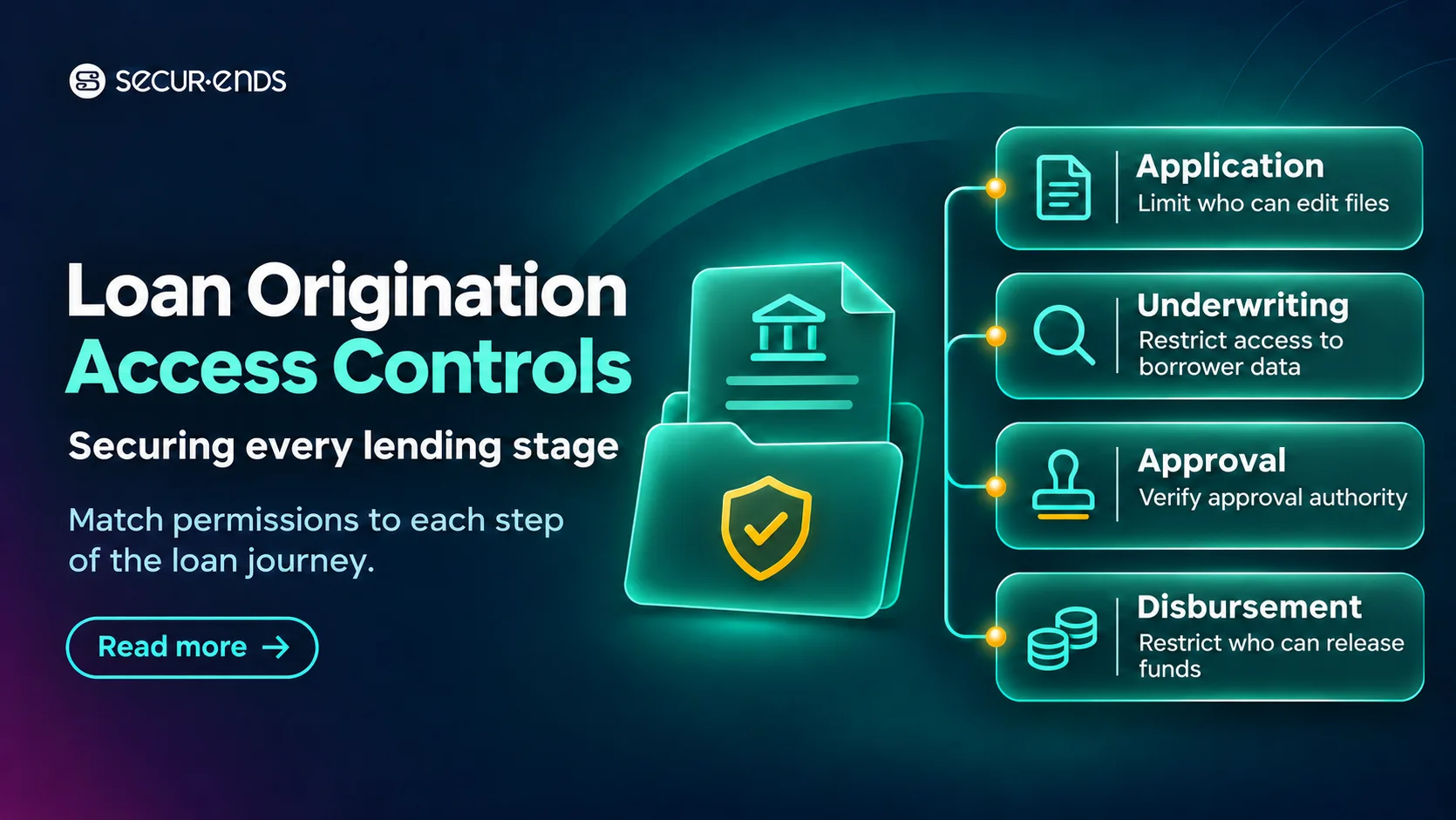
Use this illustrative map to compare the access employees need with the permissions that warrant closer review. Actual settings depend on the institution’s loan products, workflows, system capabilities, and applicable requirements.
| Lending stage | Typical access needed | Permission requiring scrutiny |
| Application intake | Create applications and collect borrower documents | Access to unrelated applicant records |
| Verification | Validate income, assets, employment, and supporting information | Unrestricted editing of verified data |
| Underwriting | Review credit information and record lending decisions | Changing approval criteria or overriding decisions |
| Approval | Authorise decisions within delegated limits | Approval beyond assigned authority |
| Funding | Execute authorised disbursement activities | Changing approved terms or funding without required controls |
| Post-approval | Complete authorised corrections and handoffs | Unrestricted modification of approved records |
Application Intake
Restrict borrower records by loan assignment, branch, team, or portfolio where the loan origination system (LOS) supports it. Check whether exported reports, document repositories, or connected applications expose records outside that scope.
Verification
Processors may need to correct borrower information. If a verified income value changes, the workflow should distinguish an authorised correction from a change that requires renewed verification. Record who made the change and when.
Underwriting
Review who can override decisions, change credit criteria, or modify information after assessment. Where automated underwriting is used, protect access to the configuration and administration of decision rules.
Approval
Compare system permissions with current delegation records. A lending manager may be authorised to approve specific products or loan amounts. Review the corresponding access whenever that authority changes.
Funding
For federal credit unions, the Federal Credit Union Act prohibits an individual from disbursing funds for a loan they approved in their capacity as a loan officer. The NCUA’s June 2020 legal interpretation recognises that certain arrangements involving administrative data entry and disbursement after automated approval may be permissible under appropriate safeguards when the employee is not acting as the approving loan officer. Assess the actual workflow and applicable requirements.
Post-Approval
Define which fields remain editable for authorised corrections, documentation updates, and handoffs. Where the system supports it, restrict sensitive fields or require renewed authorisation when material information changes.
How to Investigate Post-Approval Editing Rights
Consider a hypothetical credit union that moves funding activities to a dedicated team. Processors retain permissions from the previous workflow, including the ability to edit selected fields on approved applications. Removing all editing rights could prevent legitimate documentation corrections.
Determine What the Permission Allows
Identify which fields remain editable and whether the changes can affect approved loan amounts, terms, interest rates, or borrower information. Check whether material changes trigger renewed approval, whether the user can edit loans outside their portfolio, and whether changes are recorded with the responsible identity and timestamp.
Correct the Access and Verify the Outcome
If processors can change protected fields without the required review, revise the role to retain authorised documentation access and route sensitive changes for approval. Test representative loan scenarios before rolling out the revised role. Retain the original permission, the approved change, and evidence that the new configuration allows authorised work and blocks or routes restricted changes.
Five Tests That Reveal Whether Loan Permissions Are Working
Access certification records an authorised reviewer’s decision about who should hold a permission. Technical testing checks whether the application enforces that decision. Application owners and security teams can define tests like these for a controlled environment.
| Control test | Example test action | Expected result |
| Loan-level access | User attempts to open an unassigned loan | Access denied unless specifically authorised |
| Field-level restrictions | Processor attempts to change a protected approved field | Change blocked or routed through required authorisation |
| Approval authority | User attempts an approval beyond delegated limits | Approval prevented or appropriately escalated |
| Role-change enforcement | Transferred employee attempts to use removed privileges | Previous access no longer works |
| Audit logging | Authorised tester modifies a sensitive field | Activity is recorded with sufficient identifying detail |
Three Events That Should Trigger a Lending Access Review
Delegated Lending Authority Changes
Confirm the authorised products and limits with the lending owner before adjusting approval permissions. Check that the delegation record and application configuration agree.
An Employee Moves Between Lending Functions
A processor moving into underwriting may need new capabilities while losing the need for some processing permissions. Review application-specific assignments as well as directory memberships.
An External Support Assignment Ends
Reassess temporary access to lending configurations, integrations, and test environments when a vendor engagement changes or ends. Review associated service accounts and integration credentials according to ownership and operational purpose.
What Should a Loan Origination Access Review Produce?
A loan origination access review should connect each identity and entitlement with an accountable owner, a business purpose, and a review decision. Retain:
- The in-scope lending identities, entitlements, and current delegation records.
- Decisions to retain, modify, or revoke permissions, with reasons for exceptions and sensitive access.
- Assigned remediation actions and confirmation that approved changes took effect.
User access reviews and entitlement certification can help organise decisions and track follow-up. Fulfilment depends on the integrations and workflows configured.
When Lending Access Is Spread Across Multiple Applications
A user may lose editing rights in the LOS while retaining related permissions in core banking, document management, or servicing. Reconcile identities across those systems and check relevant directory groups, loan assignments, and application-specific privileges. Identify which application controls each permission and which team can change it.
SecurEnds supports entitlement visibility, access certifications, review workflows, and remediation tracking across connected applications. Institutions should validate the integration coverage and entitlement detail available for their environment. Identity governance across banking and lending systems provides additional context for credit unions.
How to Measure Loan Access Governance
Track measures that show where failures occur and whether corrective actions are working.
| Measure | What it reveals |
| High-risk entitlements without a current owner | Gaps in access accountability |
| Access retained after employee role changes | Potential privilege accumulation |
| Overdue revocations | Delays in reducing inappropriate access |
| Confirmed post-approval permission exceptions | Weaknesses in lending-stage restrictions |
| Failed permission enforcement tests | Configuration or workflow problems |
| Repeat findings across review periods | Issues that may require role or process redesign |
Interpret results in context. An increase in recorded exceptions may reflect better detection.
Best Practices for Loan Origination Access Controls
- Match access to the loan stage. Define which actions are permitted before and after verification, approval, and funding.
- Prioritise permissions with financial impact. Start with overrides, decision rules, delegated approvals, and disbursement.
- Test after workflow or system changes. Check that updated roles, integrations, and configurations enforce the intended restrictions.
- Verify changes in the affected application. Retain an updated access record or controlled test result showing that the revocation took effect.
Frequently Asked Questions
Can loan origination systems restrict access to individual loan applications?
Yes. Some platforms support restrictions by loan assignment, role, team, or branch. Available controls depend on the platform and configuration. Check whether users can access unassigned applications through search, reporting, integrations, or inherited permissions.
What is the difference between a loan processor’s access and an underwriter’s access?
Processors typically collect, verify, and update application information. Underwriters assess creditworthiness and make authorised lending decisions. Approval and override permissions should match documented delegated authority.
Should users retain access to approved loan applications?
Users may need continued access for authorised corrections, documentation, funding, or servicing handoffs. Define which actions remain necessary and require appropriate authorisation for material changes to approved information.
How can credit unions prevent outdated loan officer permissions after departmental transfers?
Reassess access when responsibilities change. Compare LOS roles, assigned portfolios, directory memberships, and related application permissions with the employee’s new duties. Remove unnecessary access and verify the update.
What permissions should receive the highest priority during a loan origination access review?
Prioritise permissions affecting approvals, overrides, borrower information, credit decision rules, funding, and administrative configuration. Consider financial exposure, business necessity, and existing safeguards.
Can automated underwriting eliminate the need for loan approval oversight?
No. Institutions still need oversight of decision rules, system configuration, input accuracy, exceptions, and funding. The NCUA has also discussed safeguards relevant to employee responsibilities in automated lending at federal credit unions.
What evidence proves that inappropriate loan origination access was removed?
Retain the original entitlement, approved revocation, resulting configuration change, and confirmation from the affected application. An updated access report or controlled permission test can provide that confirmation.
Match Loan Permissions to Lending Decisions
Start with post-approval editing rights, delegated approval limits, and permissions retained after employee transfers. Compare what employees can do with what their current responsibilities and the loan’s stage require. Then verify that the lending platform enforces those limits and retain evidence of the result.




