
Banking Segregation of Duties: 6 Conflicts That Need Closer Review
Banking Segregation of Duties: 6 Conflicts That Need Closer Review
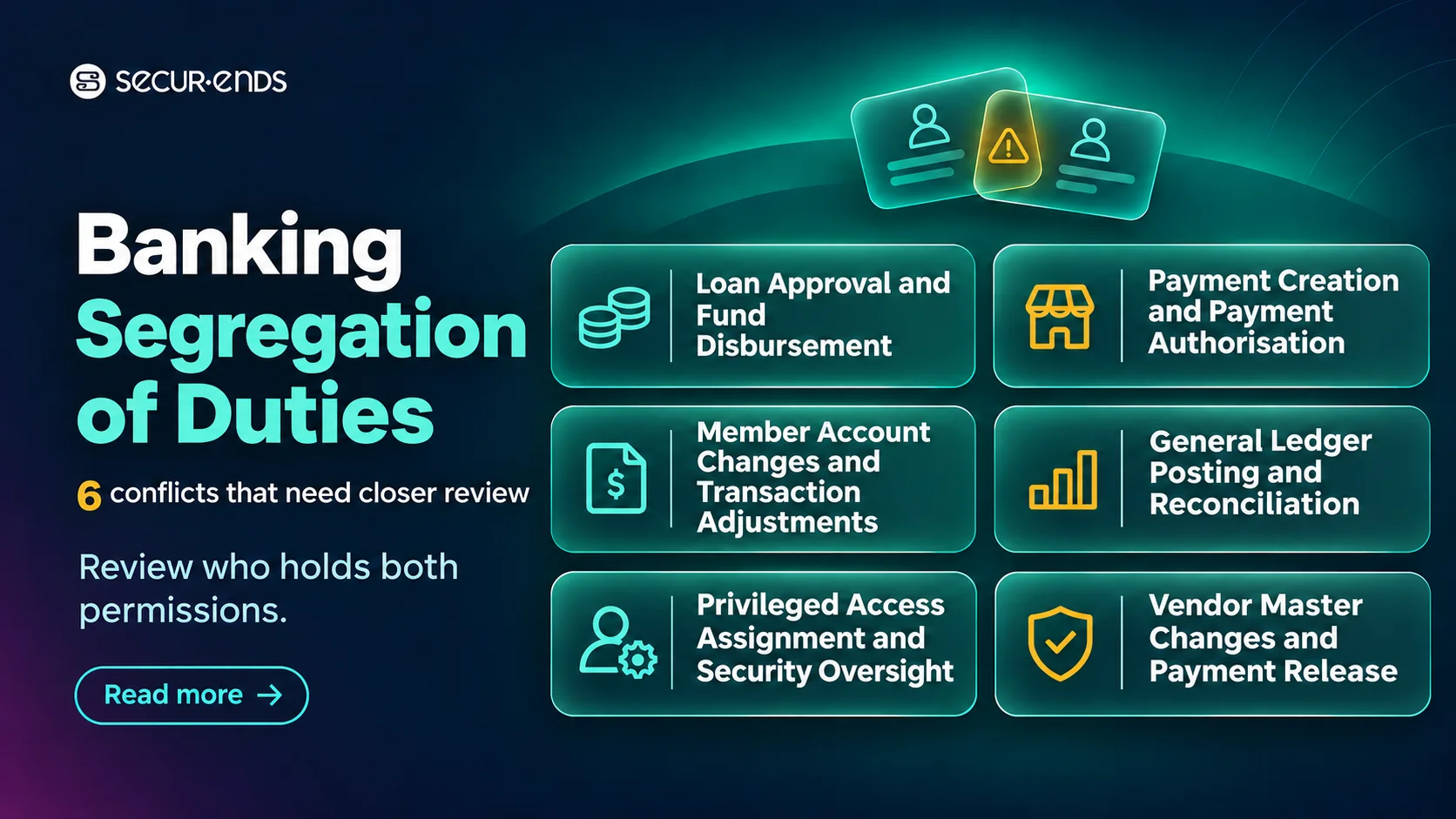
TL;DR
- Banking segregation of duties separates incompatible responsibilities across lending, payments, accounting, and IT.
- Permissions that look appropriate within individual applications can create a conflict when combined.
- Reviewers should confirm whether the same person can perform both activities within the same transaction or process.
- Resolve confirmed conflicts by removing unnecessary access, reassigning responsibilities, or using an appropriate compensating control where permitted.
- Keep evidence that access was removed or that the mitigating control operates effectively.
- SecurEnds supports cross-application SoD rules, access certifications, entitlement visibility, and review reporting.
When Loan Approval and Disbursement Overlap
A credit union’s lending system requires separate employees to approve loans and release funds. Yet an employee with permissions across multiple applications may still have enough access to influence both activities.
The institution has a separation-of-duties policy, and its systems enforce approval rules. The combined permissions can still create a risk that neither application identifies on its own. This is where banking segregation of duties requires IT, risk, and compliance teams to examine what employees can actually do across systems.
What Is Segregation of Duties in Banking?
Segregation of duties in banking is an internal-control practice that separates incompatible financial and administrative responsibilities to prevent any one person from exercising unchecked control over sensitive activities.
It helps reduce the likelihood that errors, unauthorised transactions, or inappropriate changes can be completed and concealed without independent oversight. Common examples include separating transaction initiation from approval, recording financial adjustments from reconciling them, and requesting privileged access from approving it.
The appropriate separation depends on the activity, transaction risk, applicable requirements, and effectiveness of existing controls.
Six Banking SoD Conflicts Worth Investigating
These examples show where overlapping permissions could create material exposure. Assess each combination against the institution’s actual workflows and control design.
1. Loan Approval and Fund Disbursement
A conflict can arise when a loan officer can approve a loan and release the associated funds. The Federal Credit Union Act restricts individuals from disbursing funds for loans they approved in their capacity as loan officers. NCUA’s 2020 legal interpretation addresses a separate situation involving limited data entry and disbursement after automated approval under defined safeguards.
Control to examine: Whether the same person can approve and disburse the same loan across applications or accounts.
2. Payment Creation and Payment Authorisation
A maker-checker control separates the person preparing a transfer from the person authorising its release. A conflict can arise if one individual can perform both actions through another assigned role, a privileged account, or a separate payment application.
Control to examine: Whether the system enforces separation at the individual level and records distinct authorised approvers.
3. Member Account Changes and Transaction Adjustments
An employee who can modify destination account information and approve a related payment may be able to change where funds are sent without independent verification.
Control to examine: Whether account changes affecting fund movement are independently verified before related transactions are completed.
4. General Ledger Posting and Reconciliation
Reconciliation checks whether recorded transactions are complete and accurate. Its effectiveness can diminish when the same employee can create adjustments, approve postings, and reconcile those entries, particularly for unusual or high-value adjustments.
Control to examine: Whether the person performing reconciliation is sufficiently independent of the transactions under review.
5. Privileged Access Assignment and Security Oversight
Administrators often need elevated permissions to maintain banking applications. A sensitive combination arises when an administrator can grant privileged access and alter or suppress the records used to investigate those changes.
Control to examine: Whether privileged role assignments, sensitive configuration changes, and audit-log administration receive independent oversight.
6. Vendor Master Changes and Payment Release
An employee who can modify vendor payment details and release related payments may be able to redirect funds without an independent checkpoint. Review the two permissions together even when they sit in separate applications.
Control to examine: Whether changes to sensitive vendor payment information require independent verification before payments are authorised.
Which Permissions Should a Banking SoD Matrix Review Together?
A segregation of duties matrix translates policy into specific combinations of actions that reviewers can investigate.
| Business process | Permission A | Permission B | Potential exposure | Suggested control |
| Lending | Loan approval | Related fund disbursement | Inappropriate loan release | Separate approval and disbursement authority |
| Payments | Payment initiation | Final payment authorisation | Unauthorised transfers | Enforced maker-checker control |
| Member servicing | Sensitive account changes | Related transaction approval | Unauthorised account or fund changes | Independent verification |
| Accounting | Journal adjustment | Related reconciliation approval | Concealed accounting errors | Independent reconciliation |
| Identity administration | Privilege assignment | Approval of own access changes | Unchecked privilege escalation | Independent access approval |
| Vendor payments | Payment-detail changes | Payment release | Misappropriation of funds | Verified changes and separate authorisation |
Tailor this illustrative matrix to your applications, approval limits, workflows, and applicable requirements. Record the policy owner, affected applications, exception criteria, and evidence needed to show that each mitigating control works.
How to Investigate a Cross-System Banking Conflict
Consider a hypothetical credit union where a senior lending employee holds the following permissions:
| System | Assigned access | Business justification |
| Loan origination | Loan approval | Current lending responsibility |
| Core banking | Loan disbursement | Retained from a previous assignment |
| Active Directory | Lending supervisor group | Current role |
| Reporting application | Loan activity reporting | Operational oversight |
What the Reviewer Should Determine
- Confirm account ownership and access. Check whether both accounts belong to the same individual and whether both permissions are active.
- Test the transaction. Establish whether the employee can approve and disburse the same loan. Account for transaction restrictions and separate approval requirements.
- Verify the outcome. If the business owner confirms that disbursement authority is no longer needed, revoke it and check the updated permissions in the core banking application. Retain the decision, approval, change record, and verification evidence.
Why SoD Rules Must Consider More Than Application Roles
A role that is appropriate within one application may conflict with permissions assigned elsewhere. Assess each potential conflict across four dimensions:
- Identity: Which accounts belong to the same employee, contractor, or administrator?
- Entitlements: What specific activities do those accounts permit?
- Business context: Can the permissions be combined within the same transaction or process?
- Existing controls: Do transaction limits, independent approvals, or technical restrictions address the risk?
Two permissions can look incompatible in a report even when the system prevents one person from using both on the same transaction. Validate that restriction before closing the finding. Where entitlements are spread across applications, user access certification and review workflows can help bring permissions and reviewer decisions into one process.
How Should Banks Resolve SoD Conflicts Without Disrupting Operations?
Choose a response that addresses the risk while allowing legitimate banking activities to continue.
| Finding | Recommended response | Evidence to retain |
| One permission is no longer needed | Revoke unnecessary access | Updated entitlement record |
| Both permissions are needed but can be separated | Reassign responsibilities | Revised role and approval assignments |
| A valid technical restriction already prevents the conflict | Verify and document the restriction | Control configuration and test results |
| Full separation is impractical | Assess an independent compensating control | Exception approval and control evidence |
| No reliable mitigation exists | Escalate for risk treatment | Risk assessment and management decision |
What Do Banking Regulators Expect From Segregation of Duties?
NCUA examination guidance addresses the separation of loan approval, processing, and disbursement. It also recognises that staffing limitations may require smaller credit unions to use mitigating controls. FDIC supervisory guidance discusses separation across lending, official checks, transaction processing, reconciliation, and sensitive IT activities.
The applicable obligations depend on the institution, transaction, law, and supervisory framework. Involve banking operations, risk, compliance, and application owners when defining conflict rules and documenting how controls operate.
What Makes an SoD Review Audit-Ready?
For each material finding, retain the affected identity and accounts, conflicting entitlements, applicable policy, risk assessment, reviewer, and remediation or exception decision. Include evidence of completed actions and assign an owner to any open issue.
If a review identifies 20 potential conflicts and resolves 12, rules out five, and leaves three under investigation, report each outcome. That breakdown shows which risks still need attention.
Where Identity Governance Fits Into Banking SoD Controls
Identity governance helps institutions bring together entitlement information from core banking, lending, payments, directories, and third-party systems. SecurEnds supports cross-application SoD rules, access certifications, entitlement visibility, and review reporting. Available capabilities depend on the connected applications, configured rules, and institution’s processes.
For credit unions, the identity governance framework for credit unions provides additional context for coordinating access oversight across connected systems.
Best Practices for Banking Segregation of Duties
- Remove unnecessary access where practical. Start with permissions retained after transfers, promotions, or temporary assignments.
- Use independent compensating controls where permitted. When staffing limits separation, consider supervisory checks or independent reconciliation. Assign an owner, specify when the control runs, and retain evidence that it works. Legal prohibitions and other mandatory requirements still apply.
- Reassess approved exceptions when conditions change. Staffing, transaction volumes, application functionality, and role changes can affect whether an exception remains justified.
- Verify remediation before closing a finding. Check the affected application or obtain evidence that the approved mitigating control operates effectively.
Frequently Asked Questions
What is the difference between segregation of duties and maker-checker controls in banking?
Segregation of duties is the broader practice of separating incompatible responsibilities. Maker-checker is a specific control in which one authorised person initiates an action and another independently verifies or approves it. Other banking activities may call for independent reconciliation or supervisory oversight.
Can a credit union employee enter loan data and disburse funds?
In some circumstances, yes. NCUA’s 2020 legal interpretation recognises that an employee performing limited administrative data entry may disburse funds following automated approval under appropriate safeguards, provided the employee is not functioning as the approving loan officer.
How can banks identify SoD conflicts when employees have multiple application accounts?
Link application accounts to authoritative identity records and compare each person’s combined permissions with defined conflict rules. Validate potential findings against actual workflows, approval restrictions, and system capabilities.
Are compensating controls acceptable when a small credit union cannot fully separate duties?
They may be appropriate if they adequately address the risk and comply with mandatory requirements. Examples include independent reconciliation and documented supervisory checks. Verify that the controls operate consistently.
What is the difference between an SoD conflict and an SoD violation?
An SoD conflict is a potentially incompatible combination of permissions or responsibilities. An SoD violation occurs when that combination breaches an applicable policy or requirement. Transaction restrictions may prevent an apparent conflict from being exercised.
Should privileged IT administrators be included in banking segregation of duties reviews?
Yes. Review combinations of permissions that allow administrators to change configurations, grant access, or manage security records without independent oversight. Controls may include separate approvals, restricted administrative roles, monitoring, and independent review.
How should banking compliance teams measure SoD control effectiveness?
Track confirmed high-risk conflicts, unresolved exceptions, remediation time, repeat violations, and compensating-control failures. Distinguish potential conflicts from validated findings and record whether corrective actions were verified.
Closing the Loop on Banking SoD Conflicts
Start with sensitive banking workflows and identify where one person can perform incompatible activities. Check what the individual can do across applications, test whether existing controls work, and document the outcome of each material finding. That gives banks and credit unions a record of where independent oversight is in place and where action is still needed.




