
Core Banking Access Controls That Strengthen Access Reviews
Core Banking Access Controls That Strengthen Access Reviews
TL;DR
- Core banking access controls restrict access to banking systems, records, and sensitive transactions based on job responsibilities.
- Employees can retain permissions they no longer need after changing roles.
- Prioritise reviews based on what a permission allows, who holds it, and whether it has a valid business purpose.
- Record each review decision and verify required removals in the affected system.
- SecurEnds offers user access certification, entitlement visibility, review workflows, and audit reporting.
When Old Permissions Remain After a Role Change
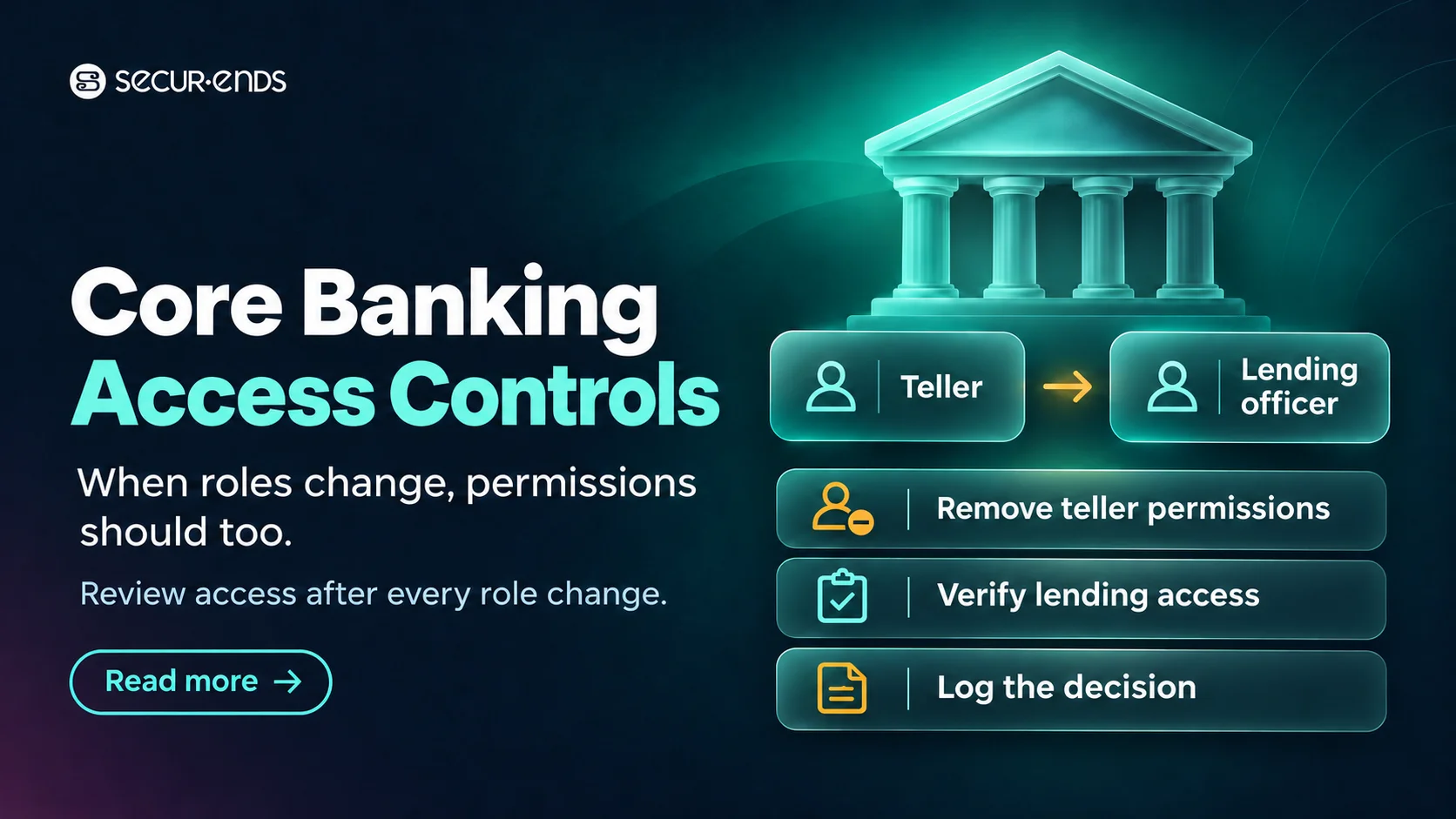
A credit union employee transfers from lending to branch operations. Their new permissions are approved, but nobody removes the loan approval privileges assigned to their previous role.
Six months later, an internal access review reveals that the employee can still approve loans outside their current responsibilities. The employee can sign in legitimately, which is why the review needs to check what they can do once they’re in the system.
What Are Core Banking Access Controls?
Core banking access controls are policies, technologies, and review processes that restrict access to banking applications, financial records, and sensitive transactions based on authorised job responsibilities.
They govern which employees, administrators, contractors, and service accounts can access critical systems and what each identity can do. These controls cover five areas:
- Authentication verifies the identity signing in.
- Authorisation defines which banking functions that identity can perform.
- Least privilege limits permissions to those needed for assigned responsibilities.
- Access reviews confirm whether existing permissions remain appropriate.
- Access revocation removes permissions when roles, employment status, or business needs change.
Where Core Banking Access Control Risks Usually Begin
Employees Accumulate Permissions Over Time
Employees who move between account servicing, lending, and branch management can accumulate permissions from several roles. This is known as privilege creep. It becomes particularly concerning when the combined permissions let one person perform incompatible activities.
Connected Banking Applications Create Visibility Gaps
Core banking, loan origination, payment processing, and financial reporting applications may each hold separate permission records. A user’s access can look appropriate in each application while the combined permissions reveal a conflict. Core banking access management should account for how entitlements work across systems.
Temporary Access Remains Active After Its Purpose Ends
A vendor may receive production access to investigate a transaction issue, or an administrator may obtain elevated privileges for an upgrade. Each exception should have a documented purpose, an accountable owner, and a review or expiry condition.
A Practical Example of Excessive Access After a Role Change
At a hypothetical mid-sized credit union, an employee moves from lending operations into branch management. The institution grants the new permissions, then identifies the following during a subsequent review:
| Application | Existing permission | Review finding | Required action |
| Core banking | Account inquiry | Still required | Retain |
| Loan origination | Loan approval authority | No longer required | Revoke |
| Active Directory | Lending security group | Outdated membership | Remove |
| Branch operations | Supervisory dashboard | Required for current role | Retain |
| Reporting system | Historical loan reports | Business need unclear | Request justification |
The reviewer can retain account inquiry, revoke loan approval, and investigate the reporting permission before deciding whether it should stay. The administrator then confirms the approved removals in the affected systems.
How to Prioritise High-Risk Banking Permissions
Prioritise access based on what it enables, who holds it, and whether the business need is documented. The table is an illustrative risk-triage model. Classifications should reflect the institution’s systems, transaction exposure, and compensating controls.
| Risk level | Access condition | Recommended response |
| Critical | Unauthorised privileged access, active access for a confirmed former employee, or a suspected compromised account | Escalate immediately and contain access according to incident procedures |
| High | Unnecessary transaction approval privileges, unexplained administrative access, or significant conflicting entitlements | Prioritise independent review and prompt remediation |
| Medium | Outdated role assignments, dormant accounts, or permissions with unclear ownership | Investigate and resolve within a documented timeframe |
| Low | Approved routine permissions aligned with current responsibilities | Retain under the established review schedule |
Three Questions That Improve Access Review Decisions
- Does the user still need this permission? Confirm the current role and business purpose.
- What could the permission allow the user to change or approve? Check sensitive operations, financial exposure, and potential conflicts.
- Can the institution demonstrate why the permission was retained? Record the reviewer’s decision and supporting evidence.
How to Conduct a Core Banking User Access Review
| Stage | Key activity | Expected evidence |
| 1. Scope | Identify critical systems, identities, and permissions | Review scope and application inventory |
| 2. Reconcile | Match application accounts to current employee and contractor records | Reconciled access inventory and exceptions |
| 3. Certify | Ask accountable owners to approve or revoke entitlements | Reviewer decisions, timestamps, and justifications |
| 4. Remediate | Remove inappropriate permissions and resolve exceptions | Change records and completed actions |
| 5. Verify | Confirm updates and preserve an audit trail | Post-remediation evidence and final review report |
Pay Particular Attention to Orphaned Accounts
Orphaned accounts lack a clearly identifiable or valid owner. They can arise after employee departures, vendor offboarding, or application migrations. Establish who owns the account and why it is needed before retaining it.
Escalate Reviews That Remain Incomplete
Define how to handle overdue decisions, unavailable reviewers, disputed entitlements, and unresolved exceptions. Track each item until a decision or corrective action is recorded.
What Do NCUA and FFIEC Guidelines Say About Access Controls?
The NCUA’s Systems/Technology guidance discusses individual credentials, job-related system permissions, dual controls, and independent review of employee access. The FFIEC Information Security guidance addresses least privilege, business-owner accountability, changes in employment responsibilities, and ongoing access reviews.
Banks and credit unions should assess their controls against applicable requirements, supervisory guidance, and institutional risk. A completed review campaign is one record of activity. The institution also needs evidence that its controls operate consistently and effectively.
What Should a Core Banking Access Audit Trail Include?
An independent reviewer should be able to reconstruct the decision from the record:
- The identity, application, and entitlement reviewed.
- The reviewer, decision date, and reason for approving or revoking access.
- The remediation completed and the evidence confirming any required removal.
For credit unions assessing a wider programme, identity governance across credit union systems provides a framework for coordinating oversight across banking applications and directories.
When Should Banks Consider Automated Access Governance?
Manual reviews can remain workable when there are few applications and reviewers. Consider automation when teams repeatedly request the same spreadsheets, struggle to match accounts to users, or spend significant time collecting audit evidence and tracking unresolved revocations.
SecurEnds offers entitlement visibility, user access certification, review workflows, and audit reporting. Evaluate how its automated user access review workflows fit your banking systems, integrations, and remediation process.
Core Banking Access Control Best Practices
- Maintain accurate identity and entitlement records. Include employees, contractors, administrators, application accounts, and relevant non-human identities. Validate the completeness of any manual exports.
- Align permissions with job responsibilities. A loan officer may need to process applications while final approval sits with a separate role.
- Apply additional oversight to privileged accounts. Identify account owners, confirm the continuing need for elevated permissions, and monitor sensitive administrative activity.
- Review access after employee changes. Trigger reassessment after transfers, departures, and contract expirations. Include application-specific accounts in offboarding checks.
- Review the entitlements held by each user. Give reviewers the current role, assigned permissions, and business justification they need to make a decision.
- Verify access removal. Compare approved revocations with the current permissions in the affected application.
Frequently Asked Questions
How often should core banking access controls be reviewed?
Set the frequency based on system sensitivity, entitlement risk, applicable requirements, and internal policy. Privileged permissions may need more frequent reviews. Role changes, departures, incidents, and significant system changes can also trigger reassessment.
What is the difference between role-based access control and user access certification?
Role-based access control defines what permissions a job role should have. User access certification checks whether each person’s actual permissions are still appropriate, including any exceptions or assignments left over from earlier roles.
What are the biggest access control risks in legacy core banking systems?
Limited entitlement reporting, outdated records, shared accounts, and restricted integrations can make it difficult to identify owners and verify access removal. Reconcile available records with authoritative identity information and apply additional oversight where needed.
Can small credit unions perform effective access reviews without dedicated IAM teams?
Yes. Clear ownership, documented permission standards, reliable system reports, and independent oversight can support effective reviews. Where staffing limits segregation of duties, documented supervisory checks can help.
How can a bank confirm that an employee’s old permissions were removed?
Check the current configuration in the affected application against the approved revocation. Retain an updated entitlement report or system confirmation as evidence.
Do third-party vendors need the same access controls as employees?
Vendor access should reflect the purpose and sensitivity of the permissions granted. Time limits, monitoring, and an accountable internal sponsor may be appropriate. Reassess access periodically and remove it when the engagement ends.
How do banks measure whether their access review process is effective?
Track review coverage, overdue decisions, high-risk exceptions, remediation time, and verified revocations. Recurring exceptions can show where access problems persist across review cycles.
Conclusion
Start with critical banking applications and permissions that allow users to approve transactions, change records, or administer systems. Confirm who owns each account, document why access is needed, and verify that approved removals took effect. This gives banks and credit unions a clearer record of what was reviewed, what changed, and what still needs attention.




