
Identity Is the New Operating System for Security, Compliance and IT
Identity Is the New Operating System for Security, Compliance and IT
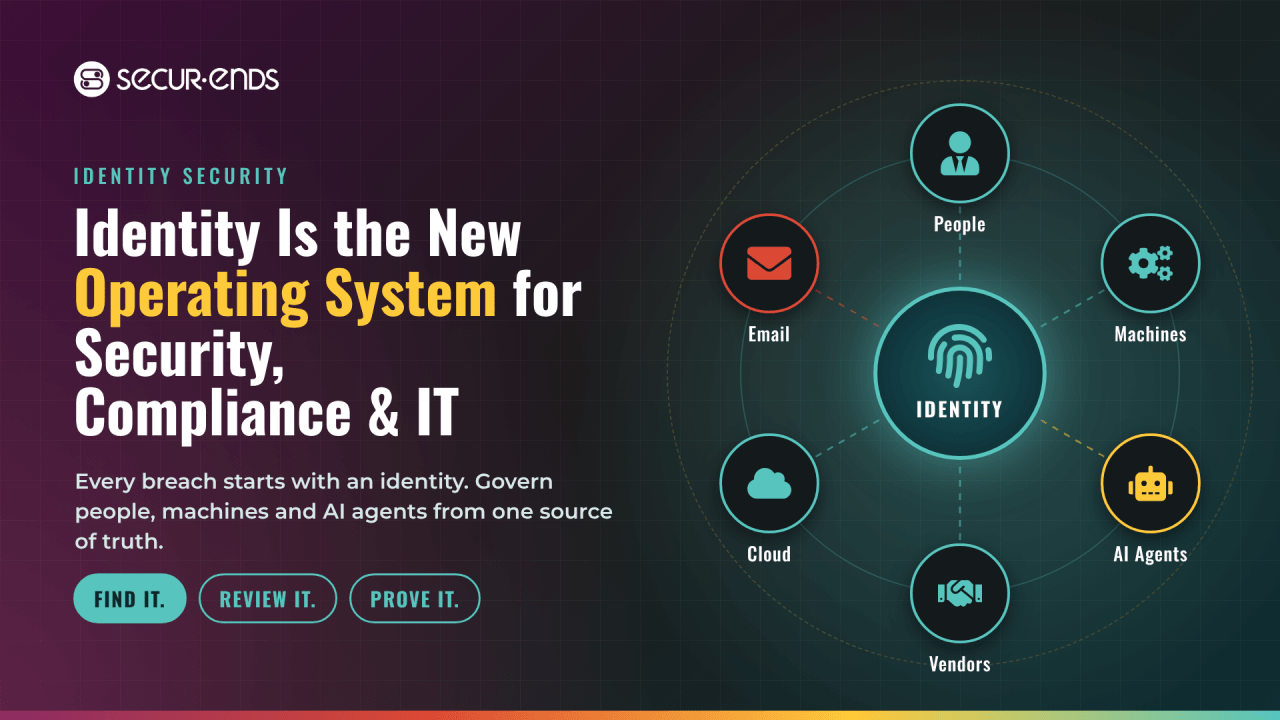
Every breach I studied started with an identity
When I was a CIO, I thought of identity as an IT chore. Create accounts, reset passwords, pass the audit. Security lived somewhere else, in firewalls and endpoint tools.
Then I started reading incident reports closely. The pattern was hard to miss. Attackers were not breaking through the firewall. They were logging in, with a stolen password, a forgotten account or a service account nobody watched.
Every audit season, the auditor asked me who has access to what. I came to see that the attacker asks the exact same question. The auditor wants the answer as proof. The attacker wants it as an opportunity.
I remember one review in particular. We found an account that belonged to a contractor who had left more than a year earlier. It still had access to a production database. To the auditor, it was a finding. To an attacker, it was an open door with a valid key. Nobody had done anything wrong on purpose. The contractor was never in the HR system, so nobody knew to remove him.
Since then I have spoken with hundreds of CIOs, CISOs and GRC leaders at banks, credit unions, hospitals, cities and manufacturers. Most of them still treat identity as a compliance task first and a security control second. Attackers count on that.
Here is what I have come to believe. Identity is the new security perimeter, and it is the operating system that security, compliance and IT all run on. Every account that should not exist is an attack path. Every unused permission is risk with no business value. Organizations that govern identity as a security control stop attacks earlier, and they pass audits as a byproduct.
Identities now outnumber the people we hire
Ten years ago, an identity was an employee with a badge and a manager. HR created it. IT disabled it. The lifecycle was simple.
That world is gone. Today every organization manages four kinds of identity:
- People. Employees, contractors, temporary staff and vendors. They change roles often and leave without notice.
- Machines. Service accounts, API keys, integrations and bots. They run payroll, move money and sync data. Most have no owner.
- AI agents. Assistants and automations that read email, write code and take actions on their own. They hold real permissions, and the business is adding them every week.
- Partners. Third parties who log into our systems, and whose systems hold our data.
Only the first group shows up in an HR system. The others appear quietly, through a project, a pilot or a purchase. Nobody removes them, because nobody knows they are there.
Attackers know this. They rarely break in anymore. They log in, with a phished password or a forgotten account that still works.
That is why the first job is discovery. In SecurEnds, Non-Human Identity Management finds the service accounts, API keys and bots across connected systems and puts an owner on each one. Nexus, our AI identity security and governance product, does the same for AI agents: it discovers them, maps what they can reach, and brings them into the same governance as people. You cannot govern what you cannot see.
Three leaders own one problem with three tools
In most organizations, identity is split three ways.
The CIO owns the systems and the onboarding. Success means people get access fast and the help desk queue stays short.
The CISO owns the risk. Success means fewer paths for an attacker, which often means less access, not more.
The GRC leader owns the proof. Success means clean audits and evidence that holds up.
Each leader buys tools for their own goal. Each tool keeps its own list of users. When the auditor asks the question, the three lists do not match. The teams spend weeks reconciling them, and the answer is out of date the day it is delivered.
This is not a people problem. These are capable leaders doing their jobs well. It is an architecture problem. We built identity as a side feature of other systems, when it should have been the foundation.
The fix is not a bigger tool for one of the three. It is one shared foundation that serves all three. The CIO gets speed, the CISO gets less risk, and the GRC leader gets proof, from the same data. That is the design principle behind the SecurEnds platform.
Five shifts separate leaders who are ahead
1. From employees to every identity
If your access review only covers people, it covers the smallest part of the risk. Service accounts and AI agents need owners, reviews and an end date, just like people. The first step is simply to find them all.
How SecurEnds helps: our Identity Governance and Administration platform connects to more than 3,000 applications, from core banking and EHR systems to Active Directory, Entra ID, Microsoft 365 and custom apps. Non-Human Identity Management and Nexus add machine and AI identities to the same inventory. One list, every identity, each with an owner.
2. From quarterly snapshots to continuous control
A quarterly review tells you what access looked like on one day. Attackers do not wait for the next quarter. Leading teams review on schedule and monitor between reviews, so a risky change is caught in days, not months.
How SecurEnds helps: user access reviews run automatically on any schedule. Between reviews, IdentityWatch continuously monitors Microsoft Entra ID for risky sign-ins, privilege changes and unusual identity behavior. Cloud Security Compliance keeps checking AWS, Azure and Google Cloud for misconfigurations and overly broad roles, so drift is caught as it happens.
3. From approvals to evidence-based decisions
Most managers approve access they cannot see. They click approve because the alternative is breaking someone’s job. Give them usage data, such as the last login or whether a permission was ever used, and the decisions change. Unused access finally gets removed.
How SecurEnds helps: IdentityWatch feeds real usage signals, such as last login and entitlement use, directly into every SecurEnds review. A manager sees that a user has not touched a system in 90 days and revokes it with one click. Separation of duties checks flag toxic combinations, such as the ability to create a vendor and pay it, before they reach an auditor.
4. From projects to configuration
Too many identity programs need developers, business analysts and a long project plan just to run a simple review. Small IT teams cannot afford that, and they should not have to. Governance should be configured by the people who run IT, not built by consultants.
How SecurEnds helps: reviews, campaigns, role templates and connectors for custom applications are configured, not coded. The same IT team that runs the business sets them up. Self-service access requests and automated provisioning and deprovisioning mean new hires are productive on day one, and leavers lose access the day they go.
5. From separate perimeters to one picture
Email, cloud, vendors and access are not separate problems. A phished password becomes an identity problem. A misconfigured cloud role becomes an access problem. A vendor login becomes a third-party risk. The leaders who are ahead look at all of it in one place.
How SecurEnds helps: SecureInbox protects email against phishing, impersonation and business email compromise, the most common way credentials are stolen. Cloud Security Compliance covers the cloud. GRC and Vendor Risk Management tracks third parties and the access they hold. Every finding maps to frameworks such as SOX, GLBA, FFIEC, HIPAA and SOC 2, so the GRC leader has the evidence in one place.
Every industry feels it differently
The question is the same everywhere. The pressure behind it is not.
Banks and credit unions run lean IT teams beside a core platform, lending systems and Microsoft 365. Examiners want GLBA and FFIEC evidence every cycle. The risk I hear about most is the former employee or vendor whose core access was never removed.
With SecurEnds, banks pull core user reports, such as Jack Henry IS9143P and IS9141P, straight into one review alongside directory and lending systems. SecureInbox stops wire-fraud email, and GRC hands examiners a complete evidence package.
Healthcare organizations manage shift workers, travel nurses and affiliated clinicians who come and go. Medical devices and integrations add machine identities nobody tracks. Email is the front door for ransomware.
With SecurEnds, hospitals review who can reach patient records, including device and integration accounts, and show HIPAA minimum-necessary access with a record of every decision. SecureInbox guards the front door.
Government agencies and cities carry long-tenured users with broad access, shared accounts and tight budgets. State frameworks raise the bar on proof every year.
SecurEnds holds TX-RAMP and COV-RAMP certifications, which matter to public buyers. Agencies use it to remove shared and orphaned accounts, check cloud configurations and produce state audit evidence on demand.
Manufacturing and logistics companies depend on ERP, partners and seasonal labor. Separation of duties in purchasing is the finding that keeps coming back.
SecurEnds enforces separation of duties in ERP and purchasing, automates access for seasonal workers and reviews partner portal access through Vendor Risk Management.
Retail lives with constant turnover and payment data. Finance teams are favorite targets for invoice and gift-card fraud by email.
SecurEnds removes store and seasonal staff the day they leave, reviews who can reach cardholder data, and uses SecureInbox to stop invoice and gift-card scams before they reach finance.
Technology companies are adopting AI agents faster than anyone. Their customers now ask for proof of access control in every security questionnaire.
With Nexus, Cloud Security Compliance and IdentityWatch, SecurEnds lets fast-growing teams inventory AI agents and cloud roles and keep SOC 2 evidence current all year. That same evidence answers customer security questionnaires faster.
Different pressures, same answer. Find every identity. Review it with real data. Prove it on demand.
One platform puts this into practice
We built SecurEnds as seven products that work as one platform. Each answers part of the question. Together they answer all of it.
- Identity Governance and Administration automates user access reviews across 3,000+ applications, plus access requests, role-based provisioning and deprovisioning, and separation of duties. It is the foundation the other products build on.
- Non-Human Identity Management finds service accounts, API keys and bots, assigns owners and reviews them with people.
- Nexus AI Identity Security and Governance discovers AI agents and governs them across five steps: discover, govern, monitor, remediate and prove.
- IdentityWatch detects identity threats in Microsoft Entra ID and feeds usage data into every review.
- Cloud Security Compliance finds cloud misconfigurations and excessive permissions and maps them to compliance frameworks.
- SecureInbox protects email against phishing, impersonation and business email compromise.
- GRC and Vendor Risk Management maps controls to frameworks, tracks third-party risk and keeps audit evidence in one place.
What ties them together is a single source of truth. The CIO sees how fast access is granted and removed. The CISO sees where risk sits right now. The GRC leader pulls proof without chasing five teams for screenshots. We hold ourselves to the same standard, with SOC 1 Type II, SOC 2 Type II, TX-RAMP and COV-RAMP certifications.
The leaders who win will share one source of truth
Here is my advice to every CIO, CISO and GRC leader reading this.
- Sit down together and ask the auditor’s question before the auditor does.
- Count every identity, not just the people. The number will surprise you.
- Measure how much granted access is never used. That number is your real attack surface.
- Ask how long it takes to remove someone who leaves, from every system.
- Stop accepting identity programs that need a services project to run a review.
The organizations that get this right will not just pass audits. They will onboard faster, recover faster and adopt AI with confidence, because they will know exactly what every identity can do.
This belief is why we built SecurEnds . Our platform brings identity governance, non-human and AI identities, threat detection, cloud compliance, email security and GRC together, so the CIO, the CISO and the GRC leader finally work from the same answer.
Find it. Review it. Prove it.
https://www.securends.com




