
AI Is Changing Cybersecurity – But Not in the Way Most People Think
AI Is Changing Cybersecurity – But Not in the Way Most People Think
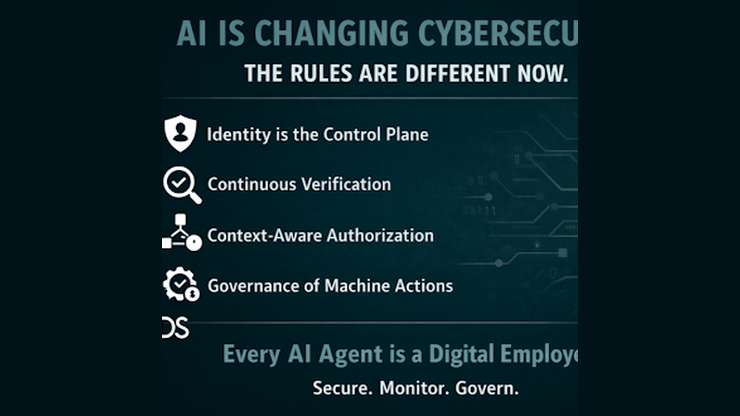
There’s a lot of noise right now about AI in cybersecurity. New tools. New buzzwords. New promises.
But if you step back, the real shift isn’t about adding AI to security. It’s about how AI changes the nature of risk itself.
For years, cybersecurity was about defending systems. Firewalls. Endpoints. Logs. Alerts.
Now we are entering a phase where software doesn’t just execute instructions — it makes decisions. And that changes everything.
The Speed Gap Is Real
Attackers are using AI to move faster than ever.
- They generate targeted phishing messages in seconds.
- They scan code at scale.
- They mimic user behavior convincingly.
- They test multiple attack paths automatically.
What used to require expertise and time now requires computation. But speed alone isn’t the biggest problem. Adaptability is.
AI-powered attacks learn as they go. They adjust. They experiment.
If your security controls are static and your adversary is adaptive, you are already behind.
Identity Is Becoming the Center of Gravity
Perimeters are gone. Cloud. APIs. Remote access. Third-party integrations.
Now add AI agents. These agents call APIs, access data, trigger workflows, and make decisions. Every one of those actions needs context.
The question is no longer just “Is this traffic malicious?” It’s “Who or what is acting, and should they have this level of access right now?”
Identity becomes the control plane. Human identities. Machine identities. AI agent identities.
If identity governance is weak, everything else is a patch.
Every AI Agent Expands the Attack Surface
This is the part many organizations underestimate. An AI agent is effectively a digital employee.
It has credentials. It has permissions. It can act at machine speed. If it’s overprivileged or poorly governed, it becomes a liability.
In the past, excessive access might sit unused for months. With AI agents, unused privilege becomes an immediate risk.
We cannot treat them like background scripts. They need all of the following.
- Authentication
- Authorization
- Monitoring
- Auditability
The same discipline we expect from humans — applied to machines.
AI Will Not Replace Security Teams — But It Will Redefine Them
Security teams are overwhelmed. More logs. More alerts. More integrations.
AI can help reduce noise, detect patterns, and predict anomalies. But here’s the key.
AI will amplify good architecture. It will expose weak architecture.
If your data model is fragmented, AI won’t magically fix it. If your identity layer is inconsistent, AI won’t secure it.
The foundation still matters. Maybe more than ever.
Zero Trust Stops Being a Framework and Becomes Reality
AI removes the concept of “trusted zones.” You cannot assume trust based on network location or historical behavior anymore.
- Verification must be continuous.
- Access must be dynamic.
- Authorization must be contextual.
This is not theory. It’s survival.
Governance Is the Real Conversation
The most important AI security discussions I’m having aren’t about tools. They’re about control.
- How do we govern autonomous decision-making?
- How do we ensure least privilege in an automated environment?
- How do we maintain auditability when machines act independently?
As AI becomes embedded in operations, cybersecurity becomes inseparable from governance. Boards will ask harder questions. And they should.
AI doesn’t just increase risk. It increases responsibility.
We are moving from securing software that follows instructions to securing systems that think, decide, and act. That’s a different category of challenge.
The companies that understand this shift early — and redesign their security architecture around identity, APIs, adaptive controls, and governance — will be the ones that stay resilient.
The rest will be reacting at machine speed. And machines don’t slow down.
Learn how SecurEnds helps with AI security. Explore Nexus AI Security




