
Identity Governance vs. AI Governance: Why You Need Both (And Why They’re Not the Same Thing)
Identity Governance vs. AI Governance: Why You Need Both (And Why They’re Not the Same Thing)
Introduction
Most security leaders I talk to have spent years building out their Identity Governance and Administration (IGA) programs. They know the playbook: provision the right access to the right people, enforce least privilege, run access certifications, prove it all to auditors. It works. It’s mature. And it’s table stakes now.
But here’s what’s changing fast: your enterprise is no longer just a collection of human identities. AI agents, autonomous bots, and machine accounts are acting on behalf of your business every single day. Calling an API. Reading a database. Triggering a workflow. Making a decision. And in many cases, doing all of this without a single human reviewing the action before it happens.
Traditional IGA wasn’t built for that. And that’s exactly why AI Governance is a different discipline — not a replacement, but a necessary extension.
I’ve spent over two decades as a CIO and now as a founder building identity security infrastructure for regulated industries. I’ve watched IGA evolve from manual spreadsheet reviews to sophisticated, automated governance platforms. And I’m watching AI Governance emerge right now as the next critical layer. The organizations that understand the distinction between these two disciplines — and build both — will be the ones that stay secure and stay compliant as AI transforms how enterprises operate.
Let me break down what each one does, where they overlap, and why ignoring either one creates serious risk.
What Identity Governance Actually Does
IGA is fundamentally about answering three questions for human users:
→ Who has access to what?
→ Should they have it?
→ Can you prove it?
It covers joiner-mover-leaver workflows, role-based access control, access certifications, segregation of duties, and compliance reporting. The identity in question is a person — an employee, a contractor, a partner.
IGA has been refined over two decades. The frameworks are solid. SOX, HIPAA, SOC 2, PCI-DSS, and ISO 27001 all depend on robust identity governance as a control foundation. The tooling is mature. The use case is well-understood.
And it still matters enormously. Identity remains the number one attack vector. Eighty percent of breaches involve compromised credentials. Threat actors don’t break in — they log in. If you haven’t locked down human identity governance, start there.
But let’s be honest about what IGA does not do. It doesn’t govern how a user behaves after access is granted. It doesn’t flag when an employee with legitimate read access to your financial database starts exporting ten times more records than usual. That’s the job of adjacent tools: UEBA, SIEM, DLP. IGA governs the permissions layer. Behavior is a different problem.
Keep that distinction in mind. It matters a lot when we talk about AI.
The Identity Explosion Nobody Planned For
Before we get to AI Governance, let’s talk about what’s already broken in most enterprise identity programs: the non-human identity problem.
Service accounts. API keys. OAuth tokens. Certificates. Bot credentials. These are non-human identities (NHIs), and most organizations have five to ten times more of them than human accounts. They’re created quickly, often without oversight, and almost never cleaned up. They accumulate excessive permissions over time because the teams that own them don’t want to deal with access issues breaking something in production.
The result: your enterprise has hundreds or thousands of machine identities with broad access to critical systems, no expiration dates, no certifications, and often no clear owner. That’s a massive attack surface. And when a bad actor compromises a service account — or when a legitimate one starts behaving unexpectedly — the blast radius is enormous.
IGA programs have historically done a poor job of governing NHIs. I’ve done access reviews with CISO teams at financial institutions and healthcare systems where we surface hundreds of orphaned service accounts they didn’t even know existed.
Fix this problem first. Because AI agents are NHIs too — and if you can’t govern a basic service account, you’re not ready to govern an AI agent.
What AI Governance Does Differently
Now add this to the picture: your organization has deployed 40, 50, maybe hundreds of AI agents. Copilots. Autonomous workflow bots. RAG-based assistants connected to your internal knowledge base. Agentic systems making API calls to third-party platforms. Each one has credentials. Each one has permissions. Each one is making calls to your systems — automatically, at scale, often without a human in the loop.
AI Governance asks a fundamentally different set of questions:
→ What is this AI agent authorized to do?
→ Is it doing what it was designed to do?
→ What data is it accessing or generating?
→ Who is accountable when it acts outside its scope?
→ Does it comply with NIST AI RMF, EU AI Act, or internal policy?
→ Has its behavior drifted since it was deployed?
→ Is it making decisions that create legal or regulatory exposure?
These are not identity questions in the traditional sense. They’re behavioral, contextual, and runtime questions. An AI agent might have perfectly valid credentials — provisioned correctly, scoped appropriately, certified last quarter — and still act in a way that violates policy, leaks sensitive data, or creates legal exposure.
A human analogy helps. Your IGA program tells you that an employee has access to the payroll system. What it doesn’t tell you is whether that employee is exporting data to a personal USB drive or making decisions outside their authority. That’s why you have monitoring, insider threat programs, and behavioral analytics.
AI agents need the same treatment — but the problem is more acute. They operate faster than humans. They scale instantly. They can make thousands of decisions per minute. And they don’t have judgment. They can drift, hallucinate, or be manipulated in ways a human actor cannot.
That’s the gap IGA alone cannot close. And it’s widening every month as AI adoption accelerates.
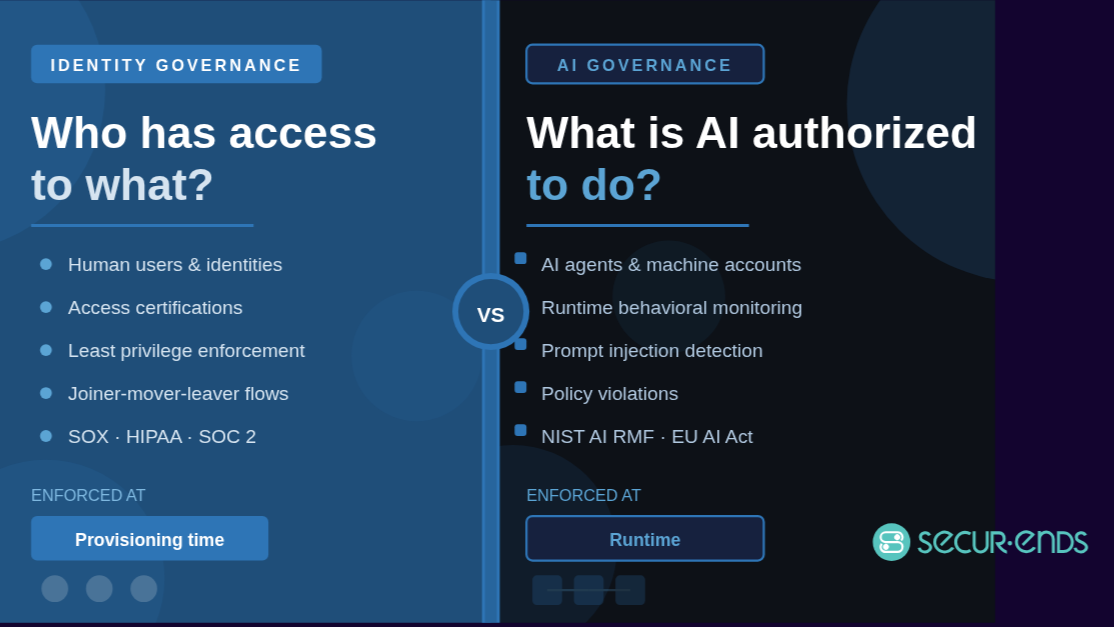
IGA vs. AI Governance: The Core Differences
These two disciplines are often confused. Here’s how they actually differ:
📌 Who they govern
IGA: Human users — employees, contractors, partners
AI Governance: AI agents, bots, and machine accounts
📌 The core question they answer
IGA: Who has access to what?
AI Governance: What is this AI authorized to do — and is it actually doing that?
📌 Where enforcement happens
IGA: At provisioning and de-provisioning time
AI Governance: At runtime, continuously, in real time
📌 The risk they address
IGA: Excessive access, orphaned accounts, segregation of duties violations
AI Governance: Unauthorized actions, data exfiltration, model drift, shadow AI
📌 The compliance framework
IGA: SOX, HIPAA, SOC 2, ISO 27001
AI Governance: NIST AI RMF, EU AI Act, SEC AI disclosure rules
📌 How accountability works
IGA: User + manager
AI Governance: Model owner, business unit, CISO
📌 The audit trail they produce
IGA: Access logs, certification records
AI Governance: Action logs, policy decisions, behavioral baselines
Different questions. Different enforcement points. Different risk profiles. But deeply complementary.
Where They Converge: Non-Human Identities
Here’s where it gets interesting. AI agents are identities. They have service accounts, API keys, OAuth tokens, and credentials just like any other NHI. That means IGA principles absolutely apply: inventory them, govern their access, enforce least privilege, rotate their credentials, and audit their activity.
If an AI agent has write access to your CRM, your production database, and your email system — and it doesn’t need all three for its defined purpose — that’s a least privilege violation. Clean it up the same way you’d clean up an over-privileged service account.
If an AI agent is decommissioned and its credentials aren’t revoked, that’s an orphaned account risk. Treat it accordingly.
If your AI agents don’t have named owners who are accountable for their behavior, you have a governance gap. The same way every user account should have an owner in your IGA system, every AI agent should have a registered owner in your governance program.
But IGA stops at the identity layer. It can tell you that an AI agent has access to your CRM. It cannot tell you whether that agent is using that access appropriately, or whether its behavior has drifted from its original purpose.
AI Governance picks up where IGA leaves off. It monitors what the agent does at runtime, enforces policy guardrails in real time, and creates an audit trail that maps actions back to intent.
The organizations winning at AI security are doing both.
The Regulatory Dimension
Neither discipline exists in a vacuum. Regulators are paying close attention to both.
On the IGA side, the requirements are well-established. SOX Section 404 requires controls over financial system access. HIPAA mandates access controls and audit trails for protected health information. PCI-DSS requires quarterly access reviews. CMMC requires strict identity governance for defense contractors.
On the AI Governance side, the landscape is moving fast. The NIST AI Risk Management Framework (AI RMF) provides a structure for governing AI systems across four functions: Govern, Map, Measure, and Manage. The EU AI Act mandates specific controls for high-risk AI applications — including requirements for human oversight, transparency, and auditability. In the US, SEC guidance on cybersecurity disclosures is beginning to capture AI-related risks. Financial regulators including the OCC and FFIEC are developing examination guidance for AI in banking.
The pattern is clear: regulators want to see AI systems governed with the same rigor applied to human access.
If you’re in a regulated industry — financial services, healthcare, government — build the AI Governance program now, before the exam cycle catches up to you.
The Risk of Treating Them as Interchangeable
I see three failure modes in the market right now.
❌ Failure Mode 1: Thinking IGA is enough
Some teams extend their IGA platform to cover service accounts and call it done. That’s better than nothing. But it leaves behavioral risk, model drift, and runtime policy enforcement completely unaddressed.
❌ Failure Mode 2: Buying AI Governance without IGA hygiene
I’ve seen organizations rush to adopt AI Governance tooling while their underlying identity program is a mess — orphaned accounts everywhere, over-privileged service accounts, no access certification cadence.
❌ Failure Mode 3: Shadow AI
Business units are deploying AI tools without involving IT or security. An operations team connects an AI agent to Salesforce using a shared API key. A marketing team plugs an AI tool into customer systems. None of it is governed.
What This Means Operationally
If you’re a CISO or IT security leader thinking through your roadmap, here’s the build sequence:
Step 1 — Start with IGA fundamentals
Step 2 — Extend to non-human identities
Step 3 — Establish an AI inventory
Step 4 — Define AI-specific policies
Step 5 — Layer AI Governance runtime controls
Step 6 — Connect accountability to both layers
Summary
Identity Governance and AI Governance are not the same discipline. They ask different questions, solve different problems, and operate at different points in the security lifecycle.
IGA governs who has access. AI Governance governs what AI agents do with that access.
One operates at provisioning time. The other operates at runtime. Both are essential.
The enterprises that will navigate the AI era securely are the ones building governance programs that span the full lifecycle — from identity provisioning through behavioral monitoring, from human accounts through autonomous agents.
AI isn’t slowing down. The agents are already in your environment. The question isn’t whether to govern them — it’s whether you’ll build the program proactively or scramble to retrofit it after something goes wrong.
Start now. Build the foundation. Layer in the controls. Connect the accountability. That’s how you govern AI without getting burned by it.




